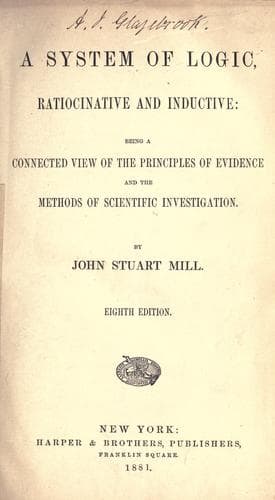
A System of Logic, Ratiocinative and InductiveMill, John Stuart
PhilosophyPhilosophy
A System of Logic, Ratiocinative and Inductive
Mill, John Stuart
Knowledge, Theory of; Logic; Science -- Methodology
This, however, though the most common, is not the only meaning which
propositions are ever intended to convey. In the first place, sequences
and co-existences are not only asserted respecting Phenomena; we make
propositions also respecting those hidden causes of phenomena, which are
named substances and attributes. A substance, however, being to us nothing
but either that which causes, or that which is conscious of, phenomena;
and the same being true, _mutatis mutandis_, of attributes; no assertion
can be made, at least with a meaning, concerning these unknown and
unknowable entities, except in virtue of the Phenomena by which alone they
manifest themselves to our faculties. When we say Socrates was
contemporary with the Peloponnesian war, the foundation of this assertion,
as of all assertions concerning substances, is an assertion concerning the
phenomena which they exhibit—namely, that the series of facts by which
Socrates manifested himself to mankind, and the series of mental states
which constituted his sentient existence, went on simultaneously with the
series of facts known by the name of the Peloponnesian war. Still, the
proposition as commonly understood does not assert that alone; it asserts
that the Thing in itself, the _noumenon_ Socrates, was existing, and doing
or experiencing those various facts during the same time. Co-existence and
sequence, therefore, may be affirmed or denied not only between phenomena,
but between noumena, or between a noumenon and phenomena. And both of
noumena and of phenomena we may affirm simple existence. But what is a
noumenon? An unknown cause. In affirming, therefore, the existence of a
noumenon, we affirm causation. Here, therefore, are two additional kinds
of fact, capable of being asserted in a proposition. Besides the
propositions which assert Sequence or Co-existence, there are some which
assert simple Existence;(36) and others assert Causation, which, subject
to the explanations which will follow in the Third Book, must be
considered provisionally as a distinct and peculiar kind of assertion.
Public-domain text, read in full here on John Shaqi.
Reviews
Reviews
No reviews yet
Be the first to share your thoughts on this work.
Elsewhere in the archive
Join the Discussion
Join the discussion
Sign in to leave a comment or review.
Sign InorCreate an account