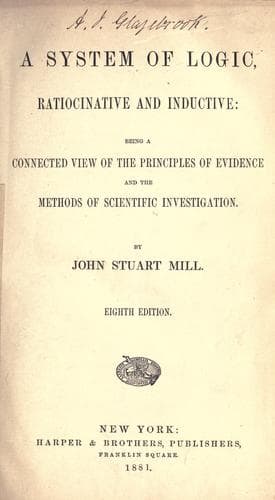
A System of Logic, Ratiocinative and InductiveMill, John Stuart
PhilosophyPhilosophy
A System of Logic, Ratiocinative and Inductive
Mill, John Stuart
Knowledge, Theory of; Logic; Science -- Methodology
§ 5. We have already proceeded far enough, not only to demonstrate the
error of Hobbes, but to ascertain the real import of by far the most
numerous class of propositions. The object of belief in a proposition,
when it asserts any thing more than the meaning of words, is generally, as
in the cases which we have examined, either the co-existence or the
sequence of two phenomena. At the very commencement of our inquiry, we
found that every act of belief implied two Things: we have now ascertained
what, in the most frequent case, these two things are, namely, two
Phenomena; in other words, two states of consciousness; and what it is
which the proposition affirms (or denies) to subsist between them, namely,
either succession or co-existence. And this case includes innumerable
instances which no one, previous to reflection, would think of referring
to it. Take the following example: A generous person is worthy of honor.
Who would expect to recognize here a case of co-existence between
phenomena? But so it is. The attribute which causes a person to be termed
generous, is ascribed to him on the ground of states of his mind, and
particulars of his conduct: both are phenomena: the former are facts of
internal consciousness; the latter, so far as distinct from the former,
are physical facts, or perceptions of the senses. Worthy of honor admits
of a similar analysis. Honor, as here used, means a state of approving and
admiring emotion, followed on occasion by corresponding outward acts.
“Worthy of honor” connotes all this, together with our approval of the act
of showing honor. All these are phenomena; states of internal
consciousness, accompanied or followed by physical facts. When we say, A
generous person is worthy of honor, we affirm co-existence between the two
complicated phenomena connoted by the two terms respectively. We affirm,
that wherever and whenever the inward feelings and outward facts implied
in the word generosity have place, then and there the existence and
manifestation of an inward feeling, honor, would be followed in our minds
by another inward feeling, approval.
After the analysis, in a former chapter, of the import of names, many
examples are not needed to illustrate the import of propositions. When
there is any obscurity, or difficulty, it does not lie in the meaning of
the proposition, but in the meaning of the names which compose it; in the
extremely complicated connotation of many words; the immense multitude and
prolonged series of facts which often constitute the phenomenon connoted
by a name. But where it is seen what the phenomenon is, there is seldom
any difficulty in seeing that the assertion conveyed by the proposition
is, the co-existence of one such phenomenon with another; or the
succession of one such phenomenon to another: so that where the one is
found, we may calculate on finding the other, though perhaps not
conversely.
Public-domain text, read in full here on John Shaqi.
Reviews
Reviews
No reviews yet
Be the first to share your thoughts on this work.
Elsewhere in the archive
Join the Discussion
Join the discussion
Sign in to leave a comment or review.
Sign InorCreate an account