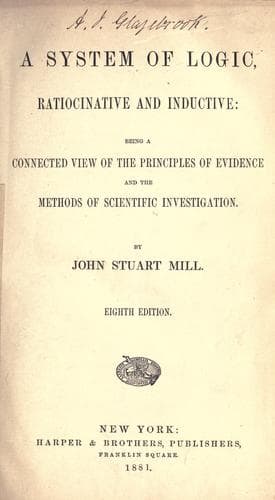
A System of Logic, Ratiocinative and InductiveMill, John Stuart
PhilosophyPhilosophy
A System of Logic, Ratiocinative and Inductive
Mill, John Stuart
Knowledge, Theory of; Logic; Science -- Methodology
There is some slight degree of foundation for this remark, but no more
than a slight degree. The arrangement of things into classes, such as the
class _metal_, or the class _man_, is grounded indeed on a resemblance
among the things which are placed in the same class, but not on a mere
general resemblance: the resemblance it is grounded on consists in the
possession by all those things, of certain common peculiarities; and those
peculiarities it is which the terms connote, and which the propositions
consequently assert; not the resemblance. For though when I say, Gold is a
metal, I say by implication that if there be any other metals it must
resemble them, yet if there were no other metals I might still assert the
proposition with the same meaning as at present, namely, that gold has the
various properties implied in the word metal; just as it might be said,
Christians are men, even if there were no men who were not Christians.
Propositions, therefore, in which objects are referred to a class because
they possess the attributes constituting the class, are so far from
asserting nothing but resemblance, that they do not, properly speaking,
assert resemblance at all.
But we remarked some time ago (and the reasons of the remark will be more
fully entered into in a subsequent Book(37)) that there is sometimes a
convenience in extending the boundaries of a class so as to include things
which possess in a very inferior degree, if in any, some of the
characteristic properties of the class—provided they resemble that class
more than any other, insomuch that the general propositions which are true
of the class, will be nearer to being true of those things than any other
equally general propositions. For instance, there are substances called
metals which have very few of the properties by which metals are commonly
recognized; and almost every great family of plants or animals has a few
anomalous genera or species on its borders, which are admitted into it by
a sort of courtesy, and concerning which it has been matter of discussion
to what family they properly belonged. Now when the class-name is
predicated of any object of this description, we do, by so predicating it,
affirm resemblance and nothing more. And in order to be scrupulously
correct it ought to be said, that in every case in which we predicate a
general name, we affirm, not absolutely that the object possesses the
properties designated by the name, but that it _either_ possesses those
properties, or if it does not, at any rate resembles the things which do
so, more than it resembles any other things. In most cases, however, it is
unnecessary to suppose any such alternative, the latter of the two grounds
being very seldom that on which the assertion is made: and when it is,
there is generally some slight difference in the form of the expression,
as, This species (or genus) is _considered_, or _may be ranked_, as
belonging to such and such a family: we should hardly say positively that
Public-domain text, read in full here on John Shaqi.
Reviews
Reviews
No reviews yet
Be the first to share your thoughts on this work.
Elsewhere in the archive
Join the Discussion
Join the discussion
Sign in to leave a comment or review.
Sign InorCreate an account