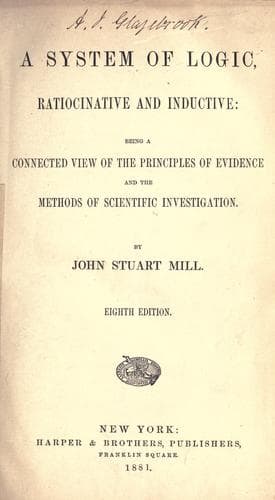
A System of Logic, Ratiocinative and InductiveMill, John Stuart
PhilosophyPhilosophy
A System of Logic, Ratiocinative and Inductive
Mill, John Stuart
Knowledge, Theory of; Logic; Science -- Methodology
it does belong to it, unless it possessed unequivocally the properties of
which the class-name is scientifically significant.
There is still another exceptional case, in which, though the predicate is
the name of a class, yet in predicating it we affirm nothing but
resemblance, the class being founded not on resemblance in any given
particular, but on general unanalyzable resemblance. The classes in
question are those into which our simple sensations, or other simple
feelings, are divided. Sensations of white, for instance, are classed
together, not because we can take them to pieces, and say they are alike
in this, and not alike in that, but because we feel them to be alike
altogether, though in different degrees. When, therefore, I say, The color
I saw yesterday was a white color, or, The sensation I feel is one of
tightness, in both cases the attribute I affirm of the color or of the
other sensation is mere resemblance—simple _likeness_ to sensations which
I have had before, and which have had those names bestowed upon them. The
names of feelings, like other concrete general names, are connotative; but
they connote a mere resemblance. When predicated of any individual
feeling, the information they convey is that of its likeness to the other
feelings which we have been accustomed to call by the same name. Thus much
may suffice in illustration of the kind of propositions in which the
matter-of-fact asserted (or denied) is simple Resemblance.
Existence, Co-existence, Sequence, Causation, Resemblance: one or other of
these is asserted (or denied) in every proposition which is not merely
verbal. This five-fold division is an exhaustive classification of
matters-of-fact; of all things that can be believed, or tendered for
belief; of all questions that can be propounded, and all answers that can
be returned to them.
Professor Bain(38) distinguishes two kinds of Propositions of
Co-existence. “In the one kind, account is taken of Place; they may be
described as propositions of Order in Place.” In the other kind, the
co-existence which is predicated is termed by Mr. Bain Co-inherence of
Attributes. “This is a distinct variety of Propositions of Co-existence.
Instead of an arrangement in place with numerical intervals, we have the
concurrence of two or more attributes or powers in the same part or
locality. A mass of gold contains, in every atom, the concurring
attributes that mark the substance—weight, hardness, color, lustre,
incorrosibility, etc. An animal, besides having parts situated in place,
has co-inhering functions in the same parts, exerted by the very same
masses and molecules of its substance.... The Mind, which affords no
Propositions of Order in Place, has co-inhering functions. We affirm mind
to contain Feeling, Will, and Thought, not in local separation, but in
commingling exercise. The concurring properties of minerals, of plants,
and of the bodily and the mental structure of animals, are united in
affirmations of co-inherence.”
Public-domain text, read in full here on John Shaqi.
Reviews
Reviews
No reviews yet
Be the first to share your thoughts on this work.
Elsewhere in the archive
Join the Discussion
Join the discussion
Sign in to leave a comment or review.
Sign InorCreate an account