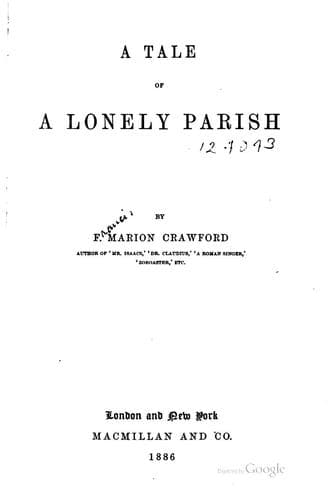
A Tale of a Lonely ParishCrawford, F. Marion (Francis Marion)
General
A Tale of a Lonely Parish
Crawford, F. Marion (Francis Marion)
Country life -- England -- Fiction; England -- Social life and customs -- Fiction
Murderer--thief, forger and murderer, too! It was more than she could
bear. Even now he was within a stone's throw of her house; a moment ago
he had been here, beside her--there beyond, too, in the dining-room,
sitting opposite to her at her own table as he had sat in his days of
innocence and honour for many a long year before his crime. In the sudden
necessity of acting, in the unutterable surprise of finding herself again
face to face with him, she had been calm; now that he was gone she felt
as though she must go mad. She asked herself if this filthy tramp, this
branded villain, was the husband she had loved and cherished for years,
whose beauty she had admired, whose hand she had held so often, whose
lips she had kissed--if this was the father of her lovely child. It was
all over now. There was blood upon his hands as well as other guilt. If
he were caught he must die, or at the very least be imprisoned for life.
He could never again be free to come forth after the expiation of his
crimes and to claim her and his child. If he escaped now, it must be to
live in a distant country under a perpetual disguise. If he were caught,
the news of his capture would be in all the papers, the news of his trial
for murder, the very details of his execution. The Ambroses would know
and the squire, even the country folk, would perhaps at last know the
truth about her. Life even in the quiet spot she had chosen would become
intolerable, and she would be obliged to go forth again into a more
distant exile. She bitterly repented having written to her husband in his
prison to tell him where she was settled. It would have been sufficient
to acquaint the governor with the fact, so that Goddard might know where
she was when his term expired. She had never written but once, and he had
perhaps not been allowed to answer the letter. His appearance at her door
proved that he had received it. Would to God he had not, she thought.
There were other things besides his crime of forgery which had acted far
more powerfully upon Mary Goddard's mind, and which had broken for ever
all ties of affection; circumstances which had appeared during his trial
and which had shown that he had not only been unfaithful to those who
trusted him, but had been unfaithful to the wife who loved him. That was
what she could not forgive; it was the memory of that which rose like an
impassable wall between her and him, worse than his frauds, his forgery,
worse almost than his murder. He had done that which even a loving woman
could not pardon, that which was past all forgiveness. That was why his
sudden appearance roused no tender memories, elicited seemingly so little
sympathy from her. She was too good a woman to say it, but she knew in
her heart that she wished him dead, the very possibility of ever seeing
him again gone from her life for ever, no matter how.
Public-domain text, read in full here on John Shaqi.
Reviews
Reviews
No reviews yet
Be the first to share your thoughts on this work.
Elsewhere in the archive
Join the Discussion
Join the discussion
Sign in to leave a comment or review.
Sign InorCreate an account