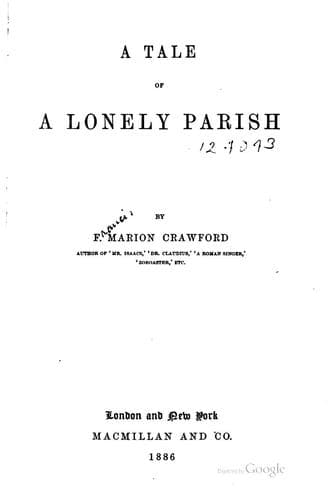
A Tale of a Lonely ParishCrawford, F. Marion (Francis Marion)
General
A Tale of a Lonely Parish
Crawford, F. Marion (Francis Marion)
Country life -- England -- Fiction; England -- Social life and customs -- Fiction
But she must see him again, nevertheless, and to-morrow. To-morrow, too,
she would have to meet the squire, and appear to act and talk as though
nothing had happened in this terrible night. That would be the hardest of
all, perhaps; even harder than meeting her husband for a brief moment in
order to give him the means of escape. She felt that in helping him she
was participating in his crimes, and yet, she asked herself, what woman
would have acted differently? What woman, even though she might hate her
husband with her whole soul, and justly, would yet be so hard-hearted as
to refuse him assistance when he was flying for his life? It would be
impossible. She must help him at any cost; but it was hard to feel that
she must see the squire and behave with indifference, while her husband
was lurking in the neighbourhood, when a detective might at any moment
come to the door, and demand to search the house.
These thoughts passed very quickly through her overwrought brain, as she
knelt in the passage; kneeling because she felt she could no longer
stand, the passionate tears streaming down her face, her small hands
pressing her temples. Then she struggled to her feet and dried her eyes,
steadying herself against the wall for a moment. She had almost forgotten
little Nellie whom she had left in the drawing-room. She had told the
child, when she went back to her, leaving Goddard alone in the dark, that
the man was a poor starving tramp, but that she did not want Nellie to
see him, because he looked so miserable. She would give him something to
eat and send him away, she said, and meanwhile Nellie should sit by the
drawing-room fire and wait for her. The child trusted her mother
implicitly and was completely reassured. Mrs. Goddard dried her eyes,
and re-entered the room. Nellie was curled up in a big chair with a book;
she looked up quickly.
"Why, mamma," she said, "you have been crying!"
"Have I, darling? I daresay it was the sight of that poor man. He was
very wretched."
"Is he gone?" asked the child.
It was unusually late and Nellie was beginning to be sleepy, so that she
was more easily quieted than she could have been in ordinary
circumstances. It might have struck her as strange that a wandering tramp
should know her mother's Christian name, as still more inexplicable that
her mother should have been willing to admit such a man at so late an
hour. She had been badly frightened, but trusting her mother as she did,
her terror had quickly disappeared and had been quickly followed by
sleepiness.
Public-domain text, read in full here on John Shaqi.
Reviews
Reviews
No reviews yet
Be the first to share your thoughts on this work.
Elsewhere in the archive
Join the Discussion
Join the discussion
Sign in to leave a comment or review.
Sign InorCreate an account