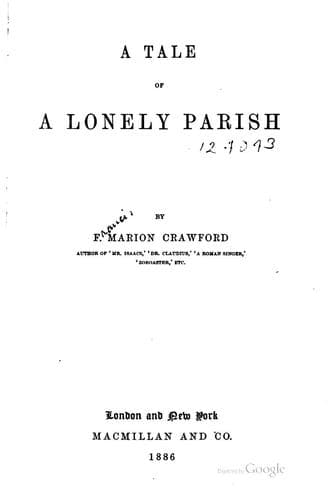
A Tale of a Lonely ParishCrawford, F. Marion (Francis Marion)
General
A Tale of a Lonely Parish
Crawford, F. Marion (Francis Marion)
Country life -- England -- Fiction; England -- Social life and customs -- Fiction
Thomas Gall, constable, was a tall fair man with a mild eye and a
cheerful face. Goodwill towards men and plentiful good living had done
their work in eradicating from the good man all that stern element which
might have been most useful to him in his career, not to say useful to
the State. Each rolling year was pricked in his leathern belt with a new
hole as his heart grew more peaceful and his body throve. He had a goodly
girth and weighed full fifteen stone in his uniform; his mild blue eye
had inspired confidence in a maiden of Billingsfield parish and Mrs. Gall
was now rearing a numerous family of little Galls, all perhaps destined
to become mild-eyed and portly village constables in their turn.
The squire, who was not destitute of a sense of humour, never thought of
Mr. Gall without a smile, so much out of keeping did the man's occupation
seem with his jovial humour. Mr. Gall, he said, was the kind of policeman
who would bribe a refractory tramp to move on by the present of a pint of
beer. But Gall had a good point. He was very proud of his profession, and
in the exercise of it he showed a discretion which, if it was the better
part of his valour, argued unlimited natural courage. It was a secret
profession, he was wont to say, and a man who could not keep a secret
would never do for a constable. He shrouded his ways in an amiable
mystery and walked a solitary beat on fine nights; when the nights were
not fine there was nobody to see whether he walked his beat or not.
Probably, he faithfully fulfilled his obligations; but his constitution
seemed to bear exposure to the weather wonderfully well. Whether he ever
saw anything worth mentioning upon those lonely walks of his, is
uncertain; at all events he never mentioned anything he saw, unless it
was in the secrecy of the reports he was supposed to transmit from time
to time to his superiors.
On the present occasion as he entered the study, the squire observed with
surprise that he looked grave. He had never witnessed such a phenomenon
before and argued that it was just possible that something of real
importance might have occurred.
"Good morning, sir," said Mr. Gall, approaching the squire respectfully,
after carefully closing the door behind him.
"Good morning, Gall. Nothing wrong, I hope?"
"Not yet, sir. I hope not, sir. Only a little matter of business, Mr.
Juxon. In point of fact, sir, I wished to consult you."
"Yes," said the squire who was used to the constable's method of
circumlocution. "Yes--what is it?"
"Well, sir--it's this," said the policeman, running his thumb round the
inside of his belt as though to test the pressure, and clearing his
throat. "There has been a general order sent down to be on the lookout,
sir. So I thought it would be best to take your opinion."
"My opinion," said the squire with great gravity, "is that if you are
directed to be on the look-out, you should be on the look-out; by all
means. What are you to be on the look-out for?"
Public-domain text, read in full here on John Shaqi.
Reviews
Reviews
No reviews yet
Be the first to share your thoughts on this work.
Elsewhere in the archive
Join the Discussion
Join the discussion
Sign in to leave a comment or review.
Sign InorCreate an account