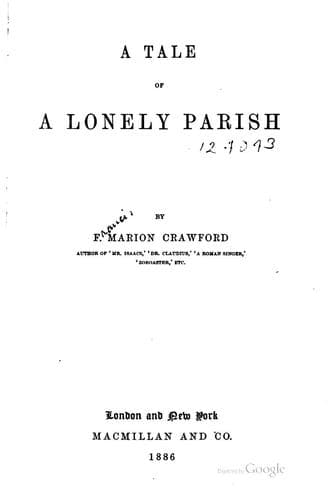
A Tale of a Lonely ParishCrawford, F. Marion (Francis Marion)
General
A Tale of a Lonely Parish
Crawford, F. Marion (Francis Marion)
Country life -- England -- Fiction; England -- Social life and customs -- Fiction
widow, she had said, "Would to God that I were!" She had said it with
such vehemence that he had felt sure that if she had indeed been a widow
her answer to himself would have been favourable. Men easily retain such
impressions received in moments of great excitement, and found hopes upon
them.
So the days had gone by and the squire had thought much but had come to
no conclusion. On the morning when Walter Goddard crept into the disused
vault at the back of the church, the squire awoke from his sleep at his
usual early hour. He was not in a very good humour, if so equable a man
could be said to be subject to such weaknesses as humours. The weather
was very depressing--day after day brought only more rain, more wind,
more mud, more of everything disagreeable. The previous evening had been
unusually dull. He was never weary of being with Mary Goddard, but
occasionally, when the Ambroses were present, the conversation became
oppressive. Mr. Juxon almost wished that John Short would come back and
cause a diversion. His views concerning John had undergone some change
since he had discovered that nobody could marry Mrs. Goddard because she
was married already. He believed he could watch John's efforts to attract
her attention with indifference now, or if without indifference with a
charitable forbearance. John at least would help to make conversation,
and the conversation on the previous evening had been intolerably
wearisome. Almost unconsciously, since the chief interest and hope of his
daily life had been removed the squire began to long for a change; he
had been a wanderer by profession during thirty years of his life and he
was perhaps not yet old enough to settle into that absolute indifference
to novelty which seems to characterise retired sailors.
But as he brushed his smooth hair and combed his beard that morning,
neither change nor excitement were very far from him. He looked over his
dressing-glass at the leafless oaks of the park, at the grey sky and the
driving rain and he wished something would happen. He wished somebody
might die and leave a great library to be sold, that he might indulge
his favourite passion; he wished he had somebody stopping in the Hall--he
almost decided to send and ask the vicar to come to lunch and have a day
among the books. As he entered the breakfast-room at precisely half-past
eight o'clock, according to his wont, the butler informed him that Mr.
Gall, the village constable, was below and wanted to see him after
breakfast. He received the news in silence and sat down to eat his
breakfast and read the morning paper. Gall had probably come about some
petty summons, or to ask what he should do about the small boys who threw
stones at the rooks and broke the church windows. After finishing his
meal and his paper in the leisurely manner peculiar to country gentlemen
who have nothing to do, the squire rang the bell, sent for the policeman
and went into his study, a small room adjoining the library.
Public-domain text, read in full here on John Shaqi.
Reviews
Reviews
No reviews yet
Be the first to share your thoughts on this work.
Elsewhere in the archive
Join the Discussion
Join the discussion
Sign in to leave a comment or review.
Sign InorCreate an account