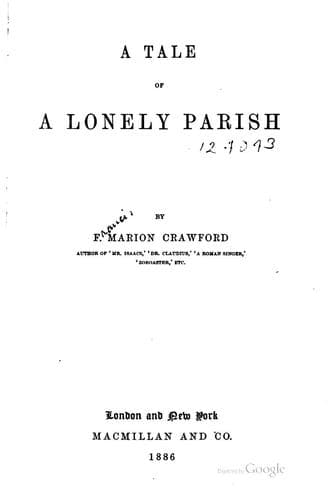
A Tale of a Lonely ParishCrawford, F. Marion (Francis Marion)
General
A Tale of a Lonely Parish
Crawford, F. Marion (Francis Marion)
Country life -- England -- Fiction; England -- Social life and customs -- Fiction
"I daresay we do," said the vicar with a smile. He was too honest to deny
it. "Indeed it took me some time to get used to the idea myself."
"Precisely. The village people would never get used to it. Of all things
to do, we should certainly not tell Gall, who is an old woman and a great
chatterbox. I wish you could have heard his statement this morning--it
filled me with admiration for the local police, I assure you. But--I
think it would be better to tell her. I did not think so before you came,
I believe. But talking always brings the truth out."
The vicar hesitated, rising and falling upon his toes and heels in
profound thought, after his manner.
"I daresay you are right," he said at last. "Will you do it? Or shall I?"
"I would rather not," said the squire, thoughtfully. "You know her
better, you have known her much longer than I."
"But she will ask me where I heard of it," objected the vicar. "I shall
be obliged to say that you told me. That will be as bad as though you
told her yourself."
"You need not say you heard it from me. You can say that Gall has
received instructions to look out for Goddard. She will not question you
any further, I am sure."
"I would much rather that you told her, Mr. Juxon," said the vicar.
"I would much rather that you told her, Mr. Ambrose," said the squire,
almost in the same breath. Both laughed a little.
"Not that I would not do it at once, if necessary," added Mr. Juxon.
"Or I, in a moment," said Mr. Ambrose.
"Of course," returned Mr. Juxon. "Only it is such a very delicate matter,
you see."
"Dear me, yes," murmured the vicar, "a most delicate matter. Poor lady!"
"Poor lady!" echoed the squire. "But I suppose it must be done."
"Oh yes--we cannot do otherwise," answered Mr. Ambrose, still hoping that
his companion would volunteer to perform the disagreeable office.
"Well then, will you--will you do it?" asked Mr. Juxon, anxious to have
the matter decided.
"Why not go together?" suggested the vicar.
"No," said Mr. Juxon firmly. "It would be an intolerable ordeal for the
poor woman. I think I see your objection. Perhaps you think that Mrs.
Ambrose--"
"Exactly, Mrs. Ambrose," echoed the vicar with a grim smile.
"Oh precisely--then I will do it," said the squire. And he forthwith did,
and was very much surprised at the result.
CHAPTER XV.
It was late in the afternoon when Mr. Juxon walked down towards the
cottage, accompanied by the vicar. In spite of their mutual anxiety to be
of service to Mrs. Goddard, when they had once decided how to act they
had easily fallen into conversation about other matters, the black letter
Paracelsus had received its full share of attention and many another rare
volume had been brought out and examined. Neither the vicar nor his host
believed that there was any hurry; if Goddard ever succeeded in getting
to Billingsfield it would not be to-day, nor to-morrow either.
Public-domain text, read in full here on John Shaqi.
Reviews
Reviews
No reviews yet
Be the first to share your thoughts on this work.
Elsewhere in the archive
Join the Discussion
Join the discussion
Sign in to leave a comment or review.
Sign InorCreate an account