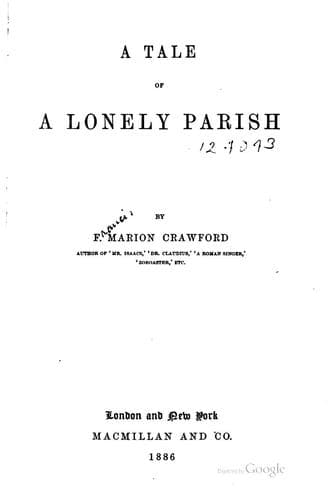
A Tale of a Lonely ParishCrawford, F. Marion (Francis Marion)
General
A Tale of a Lonely Parish
Crawford, F. Marion (Francis Marion)
Country life -- England -- Fiction; England -- Social life and customs -- Fiction
The weather had suddenly changed; the east was already clear and over the
west, where the sun was setting in a fiery mist, the huge clouds were
banked up against the bright sky, fringed with red and purple, but no
longer threatening rain or snow. The air was sharp and the plentiful mud
in the roads was already crusted with a brittle casing of ice.
The squire took leave of Mr. Ambrose at the turning where the road led
into the village and then walked back to the cottage. Even his solid
nerves were a little unsettled at the prospect of the interview
before him; but he kept a stout heart and asked for Mrs. Goddard in his
usual quiet voice. Martha told him that Mrs. Goddard had a bad headache,
but on inquiry found that she would see the squire. He entered the
drawing-room softly and went forward to greet her; she was sitting in a
deep chair propped by cushions.
Mary Goddard had spent a miserable day. The grey morning light seemed to
reveal her troubles and fears in a new and more terrible aspect. During
the long hours of darkness it seemed as though those things were
mercifully hidden which the strong glare of day must inevitably reveal,
and when the night was fairly past she thought all the world must surely
know that Walter Goddard had escaped and that his wife had seen him.
Hourly she expected a ringing at the bell, announcing the visit of a
party of detectives on his track; every sound startled her and her nerves
were strung to such a pitch that she heard with supernatural acuteness.
She had indeed two separate causes for fear. The one was due to her
anxiety for Goddard's safety; the other to her apprehensions for Nellie.
She had long determined that at all hazards the child must be kept from
the knowledge of her father's disgrace, by being made to believe in his
death. It was a falsehood indeed, but such a falsehood as may surely be
forgiven to a woman as unhappy as Mary Goddard. It seemed monstrous that
the innocent child, who seemed not even to have inherited her father's
looks or temper, should be brought up with the perpetual sense of her
disgrace before her, should be forced to listen to explanations of her
father's crimes and tutored to the comprehension of an inherited shame.
From the first Mary Goddard had concealed the whole matter from the
little girl, and when Walter was at last convicted, she had told her that
her father was dead. Dead he might be, she thought, before twelve years
were out, and Nellie would be none the wiser. In twelve years from the
time of his conviction Nellie would be in her twenty-first year; if it
were ever necessary to tell her, it would be time enough then, for the
girl would have at least enjoyed her youth, free of care and of the
horrible consciousness of a great crime hanging over her head. No child
could grow up in such a state as that implied. No mind could develop
healthily under the perpetual pressure of so hideous a secret; from her
Public-domain text, read in full here on John Shaqi.
Reviews
Reviews
No reviews yet
Be the first to share your thoughts on this work.
Elsewhere in the archive
Join the Discussion
Join the discussion
Sign in to leave a comment or review.
Sign InorCreate an account