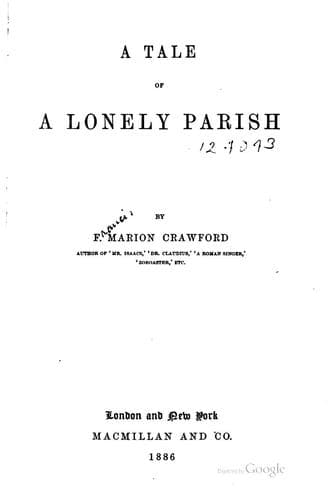
A Tale of a Lonely ParishCrawford, F. Marion (Francis Marion)
General
A Tale of a Lonely Parish
Crawford, F. Marion (Francis Marion)
Country life -- England -- Fiction; England -- Social life and customs -- Fiction
She seemed young, but he never thought of her age. In reality she was
nine-and-twenty years old but looked younger. She was pale, far paler
than the little girl, but she had those same violet eyes, large, deep and
sorrowful, beneath dark, smooth eyebrows that arched high and rose a
little in the middle. Her mouth was perhaps large for her face but her
full lips curved gently and seemed able to smile, though she was not
smiling. Her nose was perhaps too small--her face was far from
faultless--and it had the slightest tendency to turn up instead of down,
but it was so delicately modelled that an artist would have pardoned it
that deviation from the classic. Thick brown hair waved across her white
forehead and was hidden under the black bonnet and the veil thrown back
over it. She was dressed in black and the close-fitting gown showed off
with unconscious vanity the lines of a perfectly moulded and perfectly
supple figure. But it was especially her eyes which attracted John's
sudden attention at that first glance, her violet eyes, tender, sad,
almost pathetic, seeming to ask sympathy and marvellously able to command
it.
It was but for a moment that she paused. Then came the vicar, following
her from the drawing-room, and all three went on. Presently Short heard
the front door open and Mr. Ambrose shouted to the fly.
"Muggins! Muggins!"
No one had ever been able to say why Abraham Boosey, the publican, had
christened his henchman with an appellation so vulgar, to say the least
of it--so amazingly cacophonous. The man's real name was plain Charles
Bird; but Abraham Boosey had christened him Muggins and Muggins he
remained. Muggins had had some beer and was asleep, for the afternoon was
hot and he had anticipated his "fours."
Short saw his opportunity and darted out of the study to the hall where
the lady and her little girl were waiting while the vicar tried to rouse
the driver of the fly by shouting at him. John blushed again as he passed
close to the woman with the sad eyes; he could not tell why, but the
blood mounted to the very roots of his hair, and for a moment he felt
very foolish.
"I'll wake him up, Mr. Ambrose," he said, running out hatless into the
summer's sun.
"Wake up, you lazy beggar!" he shouted in the ear of the sleeping
Muggins, shaking him violently by the arm as he stood upon the wheel.
Muggins grunted something and smiled rather idiotically. "It was only the
young gentleman's play," he would have said. Bless you! he did not mind
being shaken and screamed at! He slowly turned his horses and brought the
fly up to the door. John walked back and stood waiting.
"Thank you," said the lady in a voice that made his heart jump, as she
came out from under the porch and the vicar helped her to get in. Then it
was the turn of the little girl.
"Good-bye, my dear," said the vicar kindly as he took her hand.
Public-domain text, read in full here on John Shaqi.
Reviews
Reviews
No reviews yet
Be the first to share your thoughts on this work.
Join the Discussion
Join the discussion
Sign in to leave a comment or review.
Sign InorCreate an account