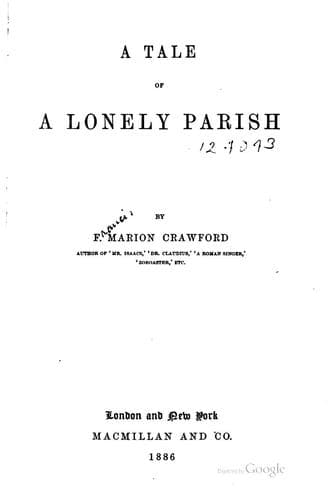
A Tale of a Lonely ParishCrawford, F. Marion (Francis Marion)
General
A Tale of a Lonely Parish
Crawford, F. Marion (Francis Marion)
Country life -- England -- Fiction; England -- Social life and customs -- Fiction
The fatigue and anxiety she had undergone during the last two days had
wrought great changes in her face. A girl of eighteen or twenty years may
gain delicacy and even beauty from the physical effects of grief, but a
woman over thirty years old gains neither. Mrs. Goddard's complexion,
naturally pale, had taken a livid hue; her lips, which were never very
red, were almost white; heavy purple shadows darkened her eyes; the two
or three lines that were hardly noticeable, but which were the natural
result of a sad expression in her face, had in two days become distinctly
visible and had almost assumed the proportions of veritable wrinkles. Her
features were drawn and pinched--she looked ten years older than she was.
Nothing remained of her beauty but her soft waving brown hair and her
deep, pathetic, violet eyes. Even her small hands seemed to have grown
thin and looked unnaturally white and transparent.
She was sitting in her favourite chair by the fire, when the vicar
arrived. She had not been willing to seem ill, in spite of what Martha
had said, and she had refused to put cushions in the chair. She was
making an effort, and even a little sense of physical discomfort helped
to make the effort seem easier. She was so much exhausted that she felt
she must not for one moment relax the tension she imposed upon herself
lest her whole remaining strength should suddenly collapse and leave her
at the mercy of events. But Mr. Ambrose was startled when he saw her and
feared that she was very ill.
"My dear Mrs. Goddard," he said, "what is the matter? Are you ill? Has
anything happened?"
As he spoke he changed the form of his question, suddenly recollecting
that Mr. Juxon had probably on the previous afternoon told her of her
husband's escape, as he had meant to do. This might be the cause of her
indisposition.
"Yes," she said in a voice that did not sound like her own, "I have asked
you to come because I am in great trouble--in desperate trouble."
"Dear me," said the vicar, "I hope not!"
"Not desperate? Perhaps not. Dear Mr. Ambrose, you have always been so
kind to me--I am sure you can help me now." Her voice trembled.
"Indeed I will do my best," said the vicar who judged from so unusual an
outburst that there must be really something wrong. "If you could tell me
what it is--" he suggested.
"That is the hardest part of it," said the unhappy woman. She paused a
moment as though to collect her strength. "You know," she began again,
"that my husband has escaped?"
"A terrible business!" exclaimed the good man, nodding, however, in
affirmation to the question she asked.
"I have seen him," said Mary Goddard very faintly, looking down at her
thin hands. The vicar started in astonishment.
"My dear friend--dear me! Dear, dear, how very painful!"
"Indeed, you do not know what I have suffered. It is most dreadful, Mr.
Ambrose. You cannot imagine what a struggle it was. I am quite worn out."
Public-domain text, read in full here on John Shaqi.
Reviews
Reviews
No reviews yet
Be the first to share your thoughts on this work.
Elsewhere in the archive
Join the Discussion
Join the discussion
Sign in to leave a comment or review.
Sign InorCreate an account