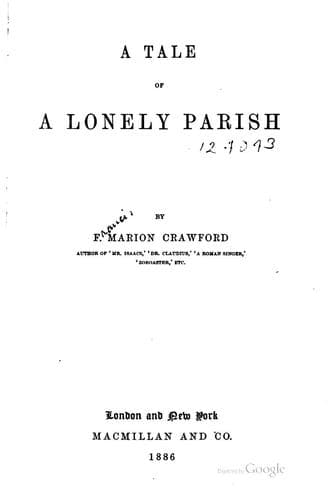
A Tale of a Lonely ParishCrawford, F. Marion (Francis Marion)
General
A Tale of a Lonely Parish
Crawford, F. Marion (Francis Marion)
Country life -- England -- Fiction; England -- Social life and customs -- Fiction
She spoke with such evident pain that the vicar was moved. He felt that
she had more to tell, but he had hardly recovered from his surprise.
"But, you know," he said, "that was the whole object of warning you. We
did not really believe that he would come here. We were so much afraid
that he would startle you. Of course Mr. Juxon told you he consulted
me--"
"Of course," answered Mrs. Goddard. "It was too late. I had seen him the
night before."
"Why, that was the very night we were here!" exclaimed Mr. Ambrose, more
and more amazed. Mrs. Goddard nodded. She seemed hardly able to speak.
"He came and knocked at that window," she said, very faintly. "He came
again last night."
"Dear me--I will send for Gall at once; he will have no difficulty in
arresting him--"
"Oh please!" interrupted Mrs. Goddard in hysterical tones. "Please,
please, dear Mr. Ambrose, don't!"
The vicar was silent. He rose unceremoniously from his chair and walked
to the window, as he generally did when in any great doubt. He realised
at once and very vividly the awful position in which the poor lady was
placed.
"Pray do not think I am very bad," said she, almost sobbing with fear and
emotion. "Of course it must seem dreadful to you that I should wish him
to escape!"
The vicar came slowly back and stood beside her leaning against the
chimney-piece. It did not take him long to make up his mind. Kind-hearted
people are generally impulsive.
"I do not, my dear lady. I assure you I fully understand your position.
The fact is, I was too much surprised and I am too anxious for your
safety not to think immediately of securing that--ahem--that unfortunate
man."
"Oh, it is not my safety! It is not only my safety--"
"I understand--yes--of course you are anxious about him. But it is
doubtless not our business to aid the law in its course, provided we do
not oppose it."
"It is something else," murmured Mrs. Goddard. "Oh! how shall I tell
you," she moaned turning her pale cheek to the back of the chair.
The vicar looked at her and began to think it was perhaps some strange
case of conscience with which he had to deal. He had very little
experience of such things save in the rude form they take among the
labouring classes. But he reflected that it was likely to be something of
the kind; in such a case Mrs. Goddard would naturally enough have sent
for him, more as her clergyman than as her friend. She looked like a
person suffering from some great mental strain. He sat down beside her
and took her passive hand. He was moved, and felt as though he might have
been her father.
"My dear," he said kindly, almost as though he were speaking to a child,
"have you anything upon your mind, anything which distresses you? Do you
wish to tell me? If so I will do my very best to help you."
Mrs. Goddard's fingers pressed his hand a little, but her face was still
turned away.
Public-domain text, read in full here on John Shaqi.
Reviews
Reviews
No reviews yet
Be the first to share your thoughts on this work.
Elsewhere in the archive
Join the Discussion
Join the discussion
Sign in to leave a comment or review.
Sign InorCreate an account