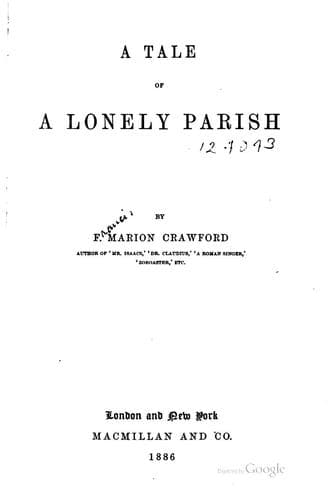
A Tale of a Lonely ParishCrawford, F. Marion (Francis Marion)
General
A Tale of a Lonely Parish
Crawford, F. Marion (Francis Marion)
Country life -- England -- Fiction; England -- Social life and customs -- Fiction
Mr. Ambrose left his friend and as he retraced his steps through the park
was more disturbed than ever. That Goddard should contemplate killing the
squire was bad enough, in all conscience, but that the squire should
deliberately purpose to hunt down Goddard with his bloodhound seemed
somehow even worse. The vicar had indeed promised Mrs. Goddard that he
would not help to capture her husband, but he would have been as glad as
any one to hear that the convict was once more lodged in his prison.
There lurked in his mind, nevertheless, an impression that even a convict
should have a fair chance. The idea was not expressed, but existed in
him. Everybody, he would have said, ought to have a fair chance, and
as the law of nations forbids the use of explosive bullets in warfare,
the laws of humanity seemed to forbid the use of bloodhounds in the
pursuit of criminals. He had a very great respect for the squire's
character and principles, but the cold-blooded way in which Mr. Juxon had
spoken of catching and probably killing Walter Goddard, had shaken the
good vicar's belief in his friend. He doubted whether he were not now
bound to return to Mrs. Goddard and to warn her in his turn of her
husband's danger, whether he ought not to do something to save the
wretched convict from his fate. It seemed hideous to think that in
peaceful Billingsfield, in his own lonely parish, a human being should be
exposed to such peril. But at this point the vicar's continuity forsook
him. He had not the heart to tell the tale of his interview with Mr.
Juxon to the unhappy lady he had left that morning. It was extremely
improbable, he thought, that she should be able to communicate with her
husband during the day, and the squire's language led him to think that
the day would not pass without some attempt to discover Walter Goddard's
hiding-place. Besides, the vicar's mind was altogether more disturbed
than it had been in thirty years, and he was no longer able to account to
himself with absolute accuracy for what he did. At all events, he felt
that it was better not to tell Mrs. Goddard what the squire had said.
When he was gone, Mr. Juxon paced his library alone in the greatest
uncertainty. He had told the vicar in his anger that he would find
Goddard with the help of Stamboul. That the hound was able to accomplish
the feat in the present weather, and if Goddard had actually stood some
time at the cottage window on the previous night, he did not doubt for a
moment. The vicar had mentioned the window to him when he told him that
Mrs. Goddard had seen her husband. He had probably been at the window as
late as midnight, and the scent, renewed by his visit, would not be
twelve hours old. Stamboul could find the man, unless he had got into a
cart, which was improbable. But a new and startling consideration
presented itself to the squire's mind when the vicar was gone and his
anger had subsided; a consideration which made him hesitate what course
to pursue.
Public-domain text, read in full here on John Shaqi.
Reviews
Reviews
No reviews yet
Be the first to share your thoughts on this work.
Elsewhere in the archive
Join the Discussion
Join the discussion
Sign in to leave a comment or review.
Sign InorCreate an account