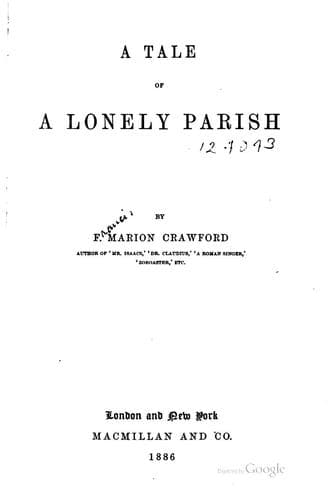
A Tale of a Lonely ParishCrawford, F. Marion (Francis Marion)
General
A Tale of a Lonely Parish
Crawford, F. Marion (Francis Marion)
Country life -- England -- Fiction; England -- Social life and customs -- Fiction
That he would be justified in using any means in his power to catch the
criminal seemed certain. It would be for the public good that he should
be delivered up to justice as soon as possible. So long as Goddard was at
large the squire's own life was not safe, and Mrs. Goddard was liable to
all kinds of annoyances at any moment. There was every reason why the
fellow should be captured. But to capture him, safe and sound, was one
thing; to expose him to the jaws of Stamboul was quite another. Mr. Juxon
had a lively recollection of the day in the Belgrade forest when the
great hound had pulled down one of his assailants, making his fangs meet
through flesh and bone. If Stamboul were set upon Goddard's track, the
convict could hardly escape with his life. In the first flush of the
squire's anger this seemed of little importance. But on mature reflection
the thing appeared in a different light.
He loved Mrs. Goddard in his own way, which was a very honourable way, if
not very passionate. He had asked her to marry him. She had expressed a
wish that she were a widow, implying perhaps that if she had been free
she would have accepted him. If the obstacle of her living husband were
removed, it was not improbable that she would look favourably upon the
squire's suit; to bring Goddard to an untimely end would undoubtedly be
to clear the way for the squire. It was not then, a legitimate desire for
justice which made him wish to catch the convict and almost to wish that
Stamboul might worry him to death; it was the secret hope that Goddard
might be killed and that he, Charles James Juxon, might have the chance
to marry his widow. "In other words," he said to himself, "I really want
to murder Goddard and take his wife."
It was not easy to see where legitimate severity ended and unlawful and
murderous selfishness began. The temptation was a terrible one. The very
uncertainty which there was, tempted the squire to disregard the
possibility of Goddard's death as compared with the importance of his
capture. It was quite likely, he unconsciously argued, that the
bloodhound would not kill him after all; it was even possible that he
might not find him; but it would be worth while to make the attempt, for
the results to be obtained by catching the fugitive were very great--Mrs.
Goddard's peace was to be considered before all things. But still before
the squire's eyes arose the picture of Stamboul tearing the throat of the
man he had killed in the Belgrade forest. If he killed the felon, Juxon
would know that to all intents and purposes he had himself done the deed
in order to marry Mrs. Goddard. But still the thought remained with him
and would not leave him.
Public-domain text, read in full here on John Shaqi.
Reviews
Reviews
No reviews yet
Be the first to share your thoughts on this work.
Elsewhere in the archive
Join the Discussion
Join the discussion
Sign in to leave a comment or review.
Sign InorCreate an account