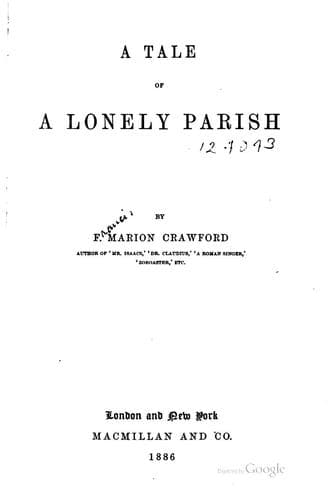
A Tale of a Lonely ParishCrawford, F. Marion (Francis Marion)
General
A Tale of a Lonely Parish
Crawford, F. Marion (Francis Marion)
Country life -- England -- Fiction; England -- Social life and customs -- Fiction
John Short was in absolute ignorance of what was occurring. He attributed
Mrs. Goddard's anxiety to her solicitude for Mr. Juxon, and if he had
found time to give the matter serious consideration, he would have argued
very naturally that she was fond of the squire. It had been less easy
than the latter had supposed to take her home and persuade her to stay
there, for she was in a state in which she hardly understood reason.
Nothing but John's repeated assurances to the effect that Mr. Juxon was
not in the least hurt, and that he would send her word of the condition
of the wounded tramp, prevailed upon her to remain at the cottage; for
she had come back to consciousness before the dog-cart was fairly out of
the park and had almost refused to enter her own home.
The catastrophe had happened, after eight and forty hours of suspense,
and her position was one of extreme fear and doubt. She had indeed seen
the squire at the very moment when she fainted, but the impression was
uncertain as that of a dream, and it required all John's asseverations to
persuade her that Mr. Juxon had actually met her and insisted that she
should return to the cottage. Once there, in her own house, she abandoned
herself to the wildest excitement, shutting herself into the drawing-room
and refusing to see anyone; she gave way to all her sorrow and fear,
feeling that if she controlled herself any longer she must go mad. Indeed
it was the best thing she could do, for her nerves were overstrained, and
the hysterical weeping which now completely overpowered her for some
time, was the natural relief to her overwrought system. She had not the
slightest doubt that the tramp of whom John had spoken, and whom he had
described as badly hurt, was her husband; and together with her joy at
Mr. Juxon's escape, she felt an intolerable anxiety to know Walter's
fate. If in ordinary circumstances she had been informed that he had died
in prison, it would have been absurd to expect her to give way to any
expressions of excessive grief; she would perhaps have shed a few womanly
tears and for some time she would have been more sad than usual; but she
no longer loved him and his death could only be regarded as a release
from all manner of trouble and shame and evil foreboding. With his
decease would have ended her fears for poor Nellie, her apprehensions for
the future in case he should return and claim her, the whole weight of
her humiliation, and if she was too kind to have rejoiced over such a
termination of her woes, she was yet too sensible not to have fully
understood and appreciated the fact of her liberation and of the freedom
given to the child she loved, by the death of a father whose return could
bring nothing but disgrace. But now she did not know whether Walter were
alive or dead. If he was alive he was probably so much injured as to
preclude all possibility of his escaping, and he must inevitably be given
up to justice, no longer to imprisonment merely, but by his own
Public-domain text, read in full here on John Shaqi.
Reviews
Reviews
No reviews yet
Be the first to share your thoughts on this work.
Elsewhere in the archive
Join the Discussion
Join the discussion
Sign in to leave a comment or review.
Sign InorCreate an account