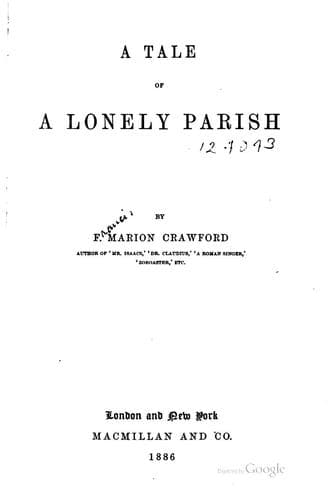
A Tale of a Lonely ParishCrawford, F. Marion (Francis Marion)
General
A Tale of a Lonely Parish
Crawford, F. Marion (Francis Marion)
Country life -- England -- Fiction; England -- Social life and customs -- Fiction
confession to suffer the death of a murderer. If on the other hand he
was already dead, he had died a death less shameful indeed, but of which
the circumstances were too horrible for his wife to contemplate, for he
must have been torn to pieces by Stamboul the bloodhound.
She unconsciously comprehended all these considerations, which entirely
deprived her of the power to weigh them in her mind, for her mind was
temporarily loosed from all control of the reasoning faculty. She had
borne much during the last three days, but she could bear no more;
intellect and sensibility were alike exhausted and gave way together.
There were indeed moments, intervals in the fits of hysteric tears
and acute mental torture, when she lay quite still in her chair and
vaguely asked herself what it all meant, but her disturbed consciousness
gave no answer to the question, and presently her tears broke out afresh
and she tossed wildly from side to side, or walked hurriedly up and down
the room, wringing her hands in despair, sobbing aloud in her agony and
again abandoning herself to the uncontrolled exaggerations of her grief
and terror. One consolation alone presented itself at intervals to her
confused intelligence; Mr. Juxon was safe. Whatever other fearful thing
had happened, he was safe, saved perhaps by her warning--but what was
that, if Walter had escaped death only to die at the hands of the
hangman, or had found it in the jaws of that fearful bloodhound? What was
the safety even of her best friend, if poor Nellie was to know that her
father was alive, only to learn that he was to die again?
But human suffering cannot outlast human strength; as a marvellous
adjustment of forces has ordered that even at the pole, in the regions of
boundless and perpetual cold, the sea shall not freeze to the bottom, so
there is also in human nature a point beyond which suffering cannot
extend. The wildest emotions must expend themselves in time, the fiercest
passions must burn out. At the end of two hours Mary Goddard was
exhausted by the vehemence of her hysteric fear, and woke as from a dream
to a dull sense of reality. She knew, now that some power of reflection
was restored to her, that the squire would give her intelligence of what
had happened, so soon as he was able, and she knew also that she must
wait until the morning before any such message could reach her. She took
the candle from the table and went upstairs. Nellie was asleep, but her
mother felt a longing to look at her again that night, not knowing what
misery for her child the morrow might bring forth.
Public-domain text, read in full here on John Shaqi.
Reviews
Reviews
No reviews yet
Be the first to share your thoughts on this work.
Elsewhere in the archive
Join the Discussion
Join the discussion
Sign in to leave a comment or review.
Sign InorCreate an account