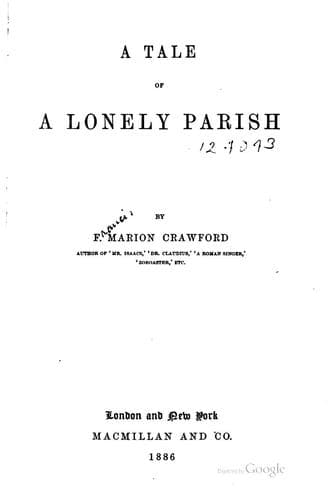
A Tale of a Lonely ParishCrawford, F. Marion (Francis Marion)
General
A Tale of a Lonely Parish
Crawford, F. Marion (Francis Marion)
Country life -- England -- Fiction; England -- Social life and customs -- Fiction
Mr. Juxon felt that it was impossible to foresee what Walter Goddard
might say in the course of another hour. He had often seen people in a
delirium and knew how strangely that inarticulate murmuring sometimes
breaks off into sudden incisive speech, astonishing every one who hears.
The man had already betrayed that he knew Mary Goddard; at the next
interval in his ravings he might betray that she was his wife. John was
still standing by the bedside, not having recovered from his
astonishment; if John heard any more, he would be in possession of Mrs.
Goddard's secret. The squire was an energetic man, equal to most
emergencies; he suddenly made up his mind.
"Mr. Short," he said, "I will tell you something. You will see the
propriety of being very discreet, in fact it is only to ensure your
discretion that I wish to tell you this much. I have reason to believe
that this fellow is a convict--do not be surprised--escaped from prison.
He is a man who once--was in love with Mrs. Goddard, which accounts for
his having found his way to Billingsfield. Yes--I know what you are going
to say--Mrs. Goddard is aware of his presence, and that accounts for her
excitement and her fainting. Do you understand?"
"But--good heavens!" exclaimed John in amazement. "Why did she not give
information, if she knew he was in the neighbourhood?"
"That would be more than could be expected of any woman, Mr. Short. You
forget that the man once loved her."
"And how did you--well, no. I won't ask any questions."
"No," said the squire, "please don't. You would be placing me in a
disagreeable position. Not that I do not trust you implicitly, Mr.
Short," he added frankly, "but I should be betraying a confidence. If
this fellow dies here, he will be buried as an unknown tramp. I found no
trace of a name upon his clothes. If he recovers, we will decide what
course to pursue. We will do our best for him--it is a delicate case of
conscience. Possibly the poor fellow would very much prefer being allowed
to die; but we cannot let him. Humanity, for some unexplained reason,
forbids euthanasia and the use of the hemlock in such cases."
"Was he sentenced for a long time?" asked John, very much impressed by
the gravity of the situation.
"Twelve years originally, I believe. Aggravated by his escape and by his
assault on me, his term might very likely be extended to twenty years if
he were taken again."
"That is to say, if he recovers?" inquired John.
"Precisely. I do not think I would hesitate to send him back to prison if
he recovered."
"I do not wonder you think he would rather die here, if he were
consulted," said John. "It would not be murder to let him die
peacefully--"
"In the opinion of the law it might be called manslaughter, though I do
not suppose anything would be said if I had simply placed him here and
omitted to call in a physician. He cannot live very long in this state,
unless something is done for him immediately. Look at him."
Public-domain text, read in full here on John Shaqi.
Reviews
Reviews
No reviews yet
Be the first to share your thoughts on this work.
Elsewhere in the archive
Join the Discussion
Join the discussion
Sign in to leave a comment or review.
Sign InorCreate an account