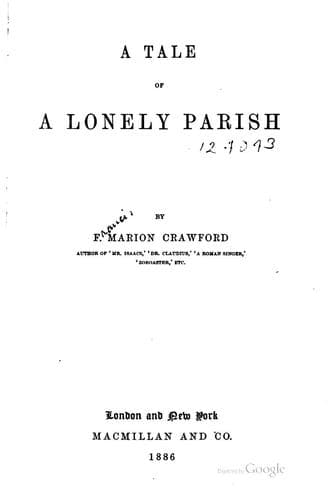
A Tale of a Lonely ParishCrawford, F. Marion (Francis Marion)
General
A Tale of a Lonely Parish
Crawford, F. Marion (Francis Marion)
Country life -- England -- Fiction; England -- Social life and customs -- Fiction
There was no apparent change in Goddard's condition. He lay upon his back
staring straight upward and mumbling aloud with every breath he drew.
"He must have been ill, before he attacked me," continued Mr. Juxon, very
much as though he were talking to himself. "He evidently is in a raging
fever--brain fever I should think. That is probably the reason why he
missed his aim--that and the darkness. If he had been well he would have
killed me fast enough with that bludgeon. As you say, Mr. Short, there is
no doubt whatever that he would prefer to die here, if he had his choice.
In my opinion, too, it would be far more merciful to him and to--to him
in fact. Nevertheless, neither you nor I would like to remember that we
had let him die without doing all we could to keep him alive. It is
a very singular case."
"Most singular," echoed John.
"Besides--there is another thing. Suppose that he had attacked me as he
did, but that I had killed him with my stick--or that Stamboul had made
an end of him then and there. The law would have said it served him
right--would it not? Of course. But if I had not quite killed him, or, as
has actually happened, he survived the embraces of my dog, the law
insists that I ought to do everything in my power to save the remnant of
his life. What for? In order that the law may give itself the
satisfaction of dealing with him according to its lights. I think the law
is very greedy, I object to it, I think it is ridiculous from that point
of view, but then, when I come to examine the thing I find that my own
conscience tells me to save him, although I think it best that he should
die. Therefore the law is not ridiculous. Pleasant dilemma--the
impossible case! The law is at the same time ridiculous and not
ridiculous. The question is, does the law deduce itself from conscience,
or is conscience the direct result of existing law?"
The squire appeared to be in a strangely moralising mood, and John
listened to him with some surprise. He could not understand that the good
man was talking to persuade himself, and to concentrate his faculties,
which had been almost unbalanced by the events of the evening.
"I think," said John with remarkable good sense, "that the instinct of
man is to preserve life when he is calm. When a man is fighting with
another he is hot and tries to kill his enemy; when the fight is over,
the natural instinct returns."
"The only thing worth knowing in such cases is the precise point at which
the fight may be said to be over. I once knew a young surgeon in India
who thought he had killed a cobra and proceeded to extract the fangs in
order to examine the poison. Unfortunately the snake was not quite dead;
he bit the surgeon in the finger and the poor fellow died in
thirty-five minutes."
"Dreadful!" said John. "But you do not think this poor fellow could do
anything very dangerous now--do you?"
Public-domain text, read in full here on John Shaqi.
Reviews
Reviews
No reviews yet
Be the first to share your thoughts on this work.
Elsewhere in the archive
Join the Discussion
Join the discussion
Sign in to leave a comment or review.
Sign InorCreate an account