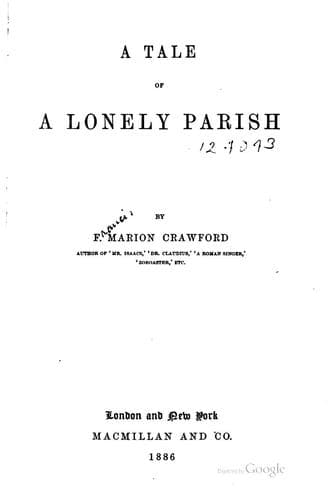
A Tale of a Lonely ParishCrawford, F. Marion (Francis Marion)
General
A Tale of a Lonely Parish
Crawford, F. Marion (Francis Marion)
Country life -- England -- Fiction; England -- Social life and customs -- Fiction
And now the time had come when he must leave all this dreaming, or at
least the scene of it, and go to college and win scholarships and renown.
It was hard to go and he showed his regret so plainly that Mrs. Ambrose
was touched at what she took for his affection for the place and for
herself and for the vicar. John Short was indeed very grateful to her for
all the kindness she had shown him, and to Mr. Ambrose for the learning
he had acquired; for John was a fine fellow and never forgot an
obligation nor undervalued one. But when we are very young our hearts are
far more easily touched to joy and sadness by the chords and discords of
our own dreaming, than by the material doings of the world around us, or
by the strong and benevolent interest our elders are good enough to take
in us. We feel grateful to those same elders if we have any good in us,
but we are far from feeling a similar interest in them. We see in our
imaginations wonderful pictures, and we hear wonderful words, for
everything we dream of partakes of an unknown perfection and completely
throws into the shade the inartistic commonplaces of daily life. As John
Short grew older, he often regretted the society of his old tutor and in
the frequent absence of important buttons from his raiment he bitterly
realised that there was no longer a motherly Mrs. Ambrose to inspect his
linen; but when he took leave of them what hurt him most was to turn his
back upon the beloved old study, upon the very door through which he had
once, and only once, beheld the ideal of his first love dream.
Though the vicar was glad to see the boy started upon what he already
regarded as a career of certain victory, he was sorry to lose him, not
knowing when he should see him again. John intended to read through all
the vacations until he got his degree. He might indeed have come down for
a day or two at Christmas, but with his very slender resources even so
short a pleasure trip was not to be thought of lightly. It was therefore
to be a long separation, so long to look forward to that when John saw
the shabby little box which contained, all his worldly goods put up into
the back of the vicar's dogcart, and stood at last in the hall, saying
good-bye, he felt as though he was being thrust out into the world never
to return again; his heart seemed to rise in his throat, the tears stood
in his eyes and he could hardly speak a word. Even then he thought of
that day when he had waked up the sleepy Muggins to take away the
beautiful unknown lady. He felt he must be quick about his leave-taking,
or he would break down.
"You have been very good to me. I--I shall never forget it," he murmured
as he shook hands with Mrs. Ambrose. "And you, too, sir--" he added
turning to the vicar. But the old clergyman cut him short, being himself
rather uncertain about the throat.
"Good-bye, my lad. God bless you. We shall hear of you soon--showing them
what you can do with your Alcaics--Good-bye."
Public-domain text, read in full here on John Shaqi.
Reviews
Reviews
No reviews yet
Be the first to share your thoughts on this work.
Join the Discussion
Join the discussion
Sign in to leave a comment or review.
Sign InorCreate an account