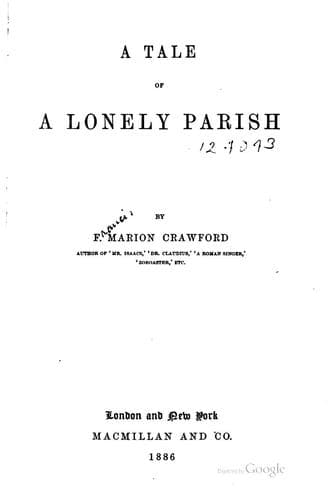
A Tale of a Lonely ParishCrawford, F. Marion (Francis Marion)
General
A Tale of a Lonely Parish
Crawford, F. Marion (Francis Marion)
Country life -- England -- Fiction; England -- Social life and customs -- Fiction
"Only two hours and a half since," he remarked. "It is just midnight now,
very good--the man must have been in a fever all day--yesterday, too,
perhaps. He is not badly hurt by the dog--like to see that dog, if you
don't mind--the fright most likely sent him into delirium. You have
nothing to accuse yourself of, Mr. Juxon: it was certainly not your
fault. Even if the dog had not bitten him, he would most likely have been
in his present state by this time. Would you mind sending for some ice at
once? Thank you. It was very lucky for the fellow that he attacked you
just when he did--secured him the chance of being well taken care of. If
he had gone off like this in the park he would have been dead before
morning."
The squire rang and sent for the ice the doctor demanded.
"Do you think he will live?" he asked nervously.
"I don't know," answered Doctor Longstreet, frankly. "Nobody can tell. He
is very much exhausted--may live two or three days in this state and then
die or go to sleep and get well--may die in the morning--often do--cannot
say. With a great deal of care, I think he has a chance."
"I am very anxious to save him," said the squire, looking hard at the
physician.
"Very good of you, I am sure," replied Doctor Longstreet, cheerfully. "It
is not everybody who would take so much trouble for a tramp. Of course if
he dies people will say your dog killed him; but I will sign a paper to
the effect that it is not true. If he had left you and your dog alone, he
would have been dead in the morning to an absolute certainty."
"How very extraordinary!" exclaimed the squire, suddenly realising that
instead of causing the man's death Stamboul had perhaps saved his life.
"It was certainly very odd that he should have chosen the best moment for
assaulting you," continued the doctor. "It is quite possible that even
then he was under some delusion--took you for somebody else--some old
enemy. People do queer things in a brain fever. By the bye has he said
anything intelligible since he has been here?"
John Short who had been standing silently by the bedside during the whole
interview looked up quickly at the squire, wondering how he would answer.
But Mr. Juxon did not hesitate.
"Yes. Twice he repeated a woman's name. That is very natural, I suppose.
Do you think he will have any lucid moments for some time?"
"May," said the doctor, "may. When he does it is likely to be at the
turning point; he will either die or be better very soon after. If it
comes soon he may say something intelligible. If he is much more
exhausted than he is now, he will understand you, but you will not
understand him. Meningitis always brings a partial paralysis of the
tongue, when the patient is exhausted. Most probably he will go on
moaning and mumbling, as he does now, for another day. You will be able
to tell by his eye whether he understands anything; perhaps he will make
some sign with his head or hand. Ah--here is the ice."
Public-domain text, read in full here on John Shaqi.
Reviews
Reviews
No reviews yet
Be the first to share your thoughts on this work.
Elsewhere in the archive
Join the Discussion
Join the discussion
Sign in to leave a comment or review.
Sign InorCreate an account