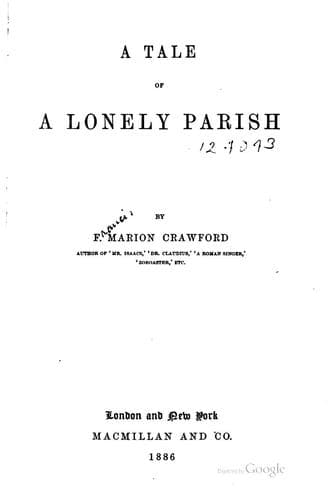
A Tale of a Lonely ParishCrawford, F. Marion (Francis Marion)
General
A Tale of a Lonely Parish
Crawford, F. Marion (Francis Marion)
Country life -- England -- Fiction; England -- Social life and customs -- Fiction
Doctor Longstreet went about his operations in a rapid and business like
fashion and John gave what assistance he could. The squire stood leaning
against the chimney-piece in deep thought.
Indeed he had enough to think of, when he had fully weighed the meaning
of the doctor's words. He was surprised beyond measure at the turn things
had taken; for although, as he had previously told John, he suspected
that Goddard must have been in a fever for several hours before the
assault, it had not struck him that Stamboul's attack had been absolutely
harmless, still less that it might prove to have been the means of saving
the convict's life. It was terribly hard to say that he desired to save
the man, and yet the honest man in his heart prayed that he might really
hope for that result. It would be far worse, should Goddard die, to
remember that he had wished for his death. But it would be hard to
imagine a more unexpected position than that in which the squire found
himself; by a perfectly natural chain of circumstances he was now tending
with the utmost care the man who had tried to murder him, and who of all
men in the world, stood most in the way of the accomplishment of his
desires.
He could not hide from himself the fact that he hated the sick man, even
though he hoped, or tried to hope for his recovery. He hated him for the
shame and suffering he had brought upon Mary Goddard in the first
instance, for the terrible anxiety he had caused her by his escape and
sudden appearance at her house; he hated him for being what he was, being
also the father of Nellie, and he hated him honestly for his base attempt
upon himself that night. He had good cause to hate him, and perhaps he
was not ashamed of his hatred. To be called upon, however, to return good
for such an accumulated mass of evil was almost too much for his human
nature. It was but a faint satisfaction to think that if he recovered he
was to be sent back to prison. Mr. Juxon did not know that there was
blood upon the man's hands--he had yet to learn that; he would not deign
to mention the assault in the park when he handed him over to the
authorities; the man should simply go back to Portland to suffer the term
of his imprisonment, as soon as he should be well enough to be moved--if
that time ever came. If he died, he should be buried decently in a
nameless grave, "six feet by four, by two," as Thomas Reid would have
said--if he died.
Public-domain text, read in full here on John Shaqi.
Reviews
Reviews
No reviews yet
Be the first to share your thoughts on this work.
Elsewhere in the archive
Join the Discussion
Join the discussion
Sign in to leave a comment or review.
Sign InorCreate an account