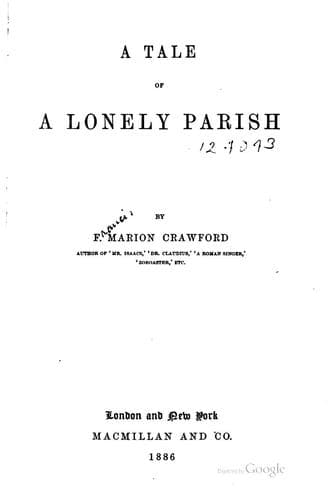
A Tale of a Lonely ParishCrawford, F. Marion (Francis Marion)
General
A Tale of a Lonely Parish
Crawford, F. Marion (Francis Marion)
Country life -- England -- Fiction; England -- Social life and customs -- Fiction
It will be seen, therefore, that if Mr. Ambrose's life had not been very
brilliant, his efforts had on the whole been attended with success. His
children were both happy and independent and no longer needed his
assistance or support; his wife, the excellent Mrs. Ambrose, enjoyed
unfailing health and good spirits; he himself was still vigorous and
active, and as yet found no difficulty in obtaining a couple of pupils at
two hundred pounds a year each, for he had early got a reputation for
successfully preparing young gentlemen with whom no other private tutor
could do anything, and he had established the scale of his prices
accordingly. It is true that he had sacrificed other things for the sake
of imparting tuition, and more than once he had hesitated and asked
himself whether he should go on. Indeed, when he graduated, it was
thought that he would soon make himself remarkable by the publication of
some scholarly work; it was foretold that he might become a famous
preacher; it was asserted that he was a general favourite with the
Fellows of Trinity and would get a proportionately fat living--but he had
committed the unpardonable sin of allowing his chances of fortune to slip
from him. He had given up his fellowship, had married and had accepted an
insignificant country living. He asked nothing, and he got nothing. He
never attracted the notice of his bishop by doing anything extraordinary,
nor the notice of the public by appearing in print. He baptized, married
and buried the people of Billingsfield, Essex, and he took private
pupils. He wrote a sermon once a fortnight, and revised old ones for the
other three occasions out of four. His sermons were good in their way,
but were intended for simple folk and did no justice to the powers he had
certainly possessed in his youth. Indeed, as years went on, the dry
routine of his life produced its inevitable effect upon his mind, and the
productions of Mr. Ambrose grew to be exceedingly commonplace; and the
more commonplace he became, the more he regretted having done so little
with the faculties he enjoyed, and the more weary he became of the daily
task of galvanising the dull minds of his pupils into a spasmodic
activity, just sufficient to leap the ditch that separates the schoolboy
from the undergraduate. He had not only educated his children and seen
them provided for in the world; he had also saved a little money, and he
had insured his life for five hundred pounds. There was no longer any
positive necessity for continuing to teach, as there had been thirty
years ago, when he first married.
Public-domain text, read in full here on John Shaqi.
Reviews
Reviews
No reviews yet
Be the first to share your thoughts on this work.
Join the Discussion
Join the discussion
Sign in to leave a comment or review.
Sign InorCreate an account