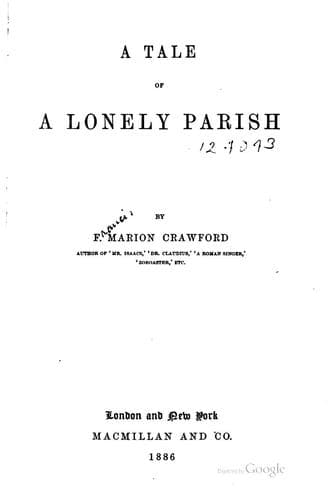
A Tale of a Lonely ParishCrawford, F. Marion (Francis Marion)
General
A Tale of a Lonely Parish
Crawford, F. Marion (Francis Marion)
Country life -- England -- Fiction; England -- Social life and customs -- Fiction
It never occurred to Mr. Ambrose's mind to tell John in the occasional
letters he wrote that Mrs. Goddard had settled in Billingsfield. John, he
thought, could take no possible interest in knowing about her, and
moreover, Mrs. Goddard herself was most anxious never to be mentioned
abroad. She had come to Billingsfield to live in complete obscurity, and
the good vicar had promised that as far as he and his wife were concerned
she should have her wish. To tell even John Short, his own beloved pupil,
would be to some extent a breach of faith, and there was assuredly no
earthly reason why John should be told. It might do harm, for of course
the young fellow had made acquaintances at Cambridge; he had probably
read about the Goddard case in the papers, and might talk about it. If he
should happen to come down for a day or two he would probably meet her;
but that could not be avoided. It was not likely that he would come for
some time. The vicar himself intended to go up to Cambridge for a day or
two after Christmas to see him; but the winter flew by and Mr. Ambrose
did not go. Then came Easter, then the summer and the Long vacation. John
wrote that he could not leave his books for a day, but that he hoped to
run down next Christmas. Again he did not come, but there came the news
of his having won another and a more important scholarship; the news also
that he was already regarded as the most promising man in the university,
all of which exceedingly delighted the heart of the Reverend Augustin
Ambrose, and being told with eulogistic comments to Mrs. Goddard, tended
to increase the interest she felt in the existence of John Short, so that
she began to long for a sight of him, without exactly knowing why.
Gradually, too, as she and her little girl passed many peaceful days in
the quiet cottage, the sad woman's face grew less sorrowful. She spoke of
herself more cheerfully and dwelt less upon the subject of her grief. She
had at first been so miserable that she could hardly talk at all without
referring to her unhappy situation though, after her first interview with
Mrs. Ambrose, no one had ever heard her mention any details connected
with her trouble. But now she never approached the subject at all. Her
face lost none of its pathetic beauty, it is true, but it seemed to
express sorrow past rather than present. Meanwhile little Nellie grew
daily more lovely, and absorbed more and more of her mother's attention.
CHAPTER IV.
Public-domain text, read in full here on John Shaqi.
Reviews
Reviews
No reviews yet
Be the first to share your thoughts on this work.
Join the Discussion
Join the discussion
Sign in to leave a comment or review.
Sign InorCreate an account