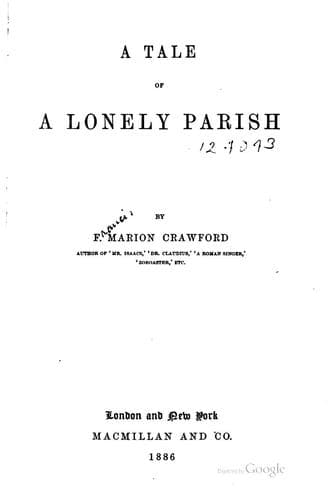
A Tale of a Lonely ParishCrawford, F. Marion (Francis Marion)
General
A Tale of a Lonely Parish
Crawford, F. Marion (Francis Marion)
Country life -- England -- Fiction; England -- Social life and customs -- Fiction
"What is a book fancier, mamma?" asked little Eleanor in a whisper. But
Mr. Juxon heard the child's question.
"If your mamma will bring you up to the Hall one of these days, Miss
Goddard, I will show you. A book fancier is a terrible fellow who has
lots of books, and is pursued by a large evil genius telling him he must
buy every book he sees, and that he will never by any possibility read
half of them before he dies."
Little Eleanor stared for a moment with her great violet eyes, and then
turning again to her mother, whispered in her ear.
"Mamma, he called me Miss Goddard!"
"Run out and play in the garden, darling," said her mother with a smile.
But the child would not go and sat down on a stool and stared at the
squire, who was immensely delighted.
"So you are going to bring all your library, Mr. Juxon?" asked the vicar
returning to the charge.
"Yes--and I beg you will make any use of it you please," answered the
visitor. "I have a great fondness for books and I think I have some
valuable volumes. But I am no great scholar, as you are, though I read a
great deal. I have always noticed that the men who accumulate great
libraries do not know much, and the men who know a great deal have very
few books. Now I will wager that you have not a thousand volumes in your
house, Mr. Ambrose."
"Five hundred would be nearer the mark," said the vicar.
"The fewer one has the nearer one approaches to Aquinas's _homo unius
libri_," returned the squire. "You are nine thousand five hundred degrees
nearer to ideal wisdom than I am."
Mr. Ambrose laughed.
"Nevertheless," he said, "you may be sure that if you give me leave to
use your books, I will take advantage of the permission. It is in writing
sermons that one feels the want of a good library."
"I should think it would be an awful bore to write sermons," remarked the
squire with such perfect innocence that both the vicar and Mrs. Goddard
laughed loudly. But Mrs. Ambrose eyed Mr. Juxon with renewed severity.
"I should fancy it would be a much greater bore, as you call it, to the
congregation if my husband never wrote any new ones," she said stiffly.
Whereat the squire looked rather puzzled, and coloured a little. But Mr.
Ambrose came to the rescue.
"Yes, indeed, my wife is quite right. There are no people with such
terrible memories as churchwardens. They remember a sermon twenty years
old. But as you say, the writing of sermons is not an easy task when a
man has been at it for thirty years and more. A man begins by being
enthusiastic, then his mind gets into a groove and for some time, if he
happens to like the groove, he writes very well. But by and by he has
written all there is to be said in the particular line he has chosen and
he does not know how to choose another. That is the time when a man needs
a library to help him."
"I really don't think you have reached that point, Mr. Ambrose," remarked
Mrs. Goddard. She admired the vicar and liked his sermons.
Public-domain text, read in full here on John Shaqi.
Reviews
Reviews
No reviews yet
Be the first to share your thoughts on this work.
Join the Discussion
Join the discussion
Sign in to leave a comment or review.
Sign InorCreate an account