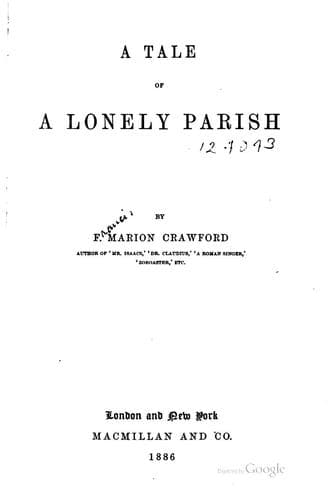
A Tale of a Lonely ParishCrawford, F. Marion (Francis Marion)
General
A Tale of a Lonely Parish
Crawford, F. Marion (Francis Marion)
Country life -- England -- Fiction; England -- Social life and customs -- Fiction
But Mrs. Goddard was very thoughtful. She was not pleased at the fact of
an addition to the Billingsfield community, and yet she liked the
appearance of the squire. He had declared his intention of calling upon
her on the following day, and she would be bound to receive him. She was
young, she had been shut off from the world for two years, and the
prospect of Mr. Juxon's acquaintance was in itself not unpleasant; but
the idea that he was to be permanently established in the Hall frightened
her. She had felt since she came to Billingsfield that from the very
first she had put herself upon a footing of safety by telling her story
to the vicar. But the vicar would, not without her permission repeat that
story to Mr. Juxon. Was she herself called upon to do so? She was a very
sensitive woman, and her impressionable nature had been strongly affected
by what she had suffered. An almost morbid fear of seeming to make false
pretences possessed her. She was more than thirty years of age, it is
true, but she saw plainly enough in her glass that she was more than
passably good-looking still. There were one or two grey threads in her
brown waving hair and she took no trouble to remove them; no one ever
noticed them. There were one or two lines, very faint lines, in her
forehead; no one ever saw them. She could hardly see them herself.
Supposing--why should she not suppose it?--supposing Mr. Juxon were to
take a fancy to her, as a lone bachelor of forty and odd might easily
take a fancy to a pretty woman who was his tenant and lived at his gate,
what should she do? He was an honest man, and she was a conscientious
woman; she could not deceive him, if it came to that. She would have to
tell him the whole truth. As she thought of it, she turned pale and
trembled. And yet she had liked his face, she had told him he might call
at the cottage, and her woman's instinct foresaw that she was to see him
often. It was not vanity which made her think that the squire might grow
to like her too much. She had had experiences in her life and she knew
that she was attractive; the very fear she had felt for the last two
years lest she should be thrown into the society of men who might be
attracted by her, increased her apprehension tenfold. She could not look
forward with indifference to the expected visit, for the novelty of
seeing any one besides the vicar and his wife was too great; she could
not refuse to see the squire, for he would come again and again until she
received him; and yet, she could not get rid of the idea that there was
danger in seeing him. Call it as one may, that woman's instinct of peril
is rarely at fault.
In the late twilight of the June evening Mrs. Goddard and Eleanor waited
home together by the broad road which led towards the park gate.
"Don't you think Mr. Juxon is very kind, mamma?" asked the child.
"Yes, darling, I have no doubt he is. It was very good of him to ask you
to go to the Hall."
Public-domain text, read in full here on John Shaqi.
Reviews
Reviews
No reviews yet
Be the first to share your thoughts on this work.
Join the Discussion
Join the discussion
Sign in to leave a comment or review.
Sign InorCreate an account