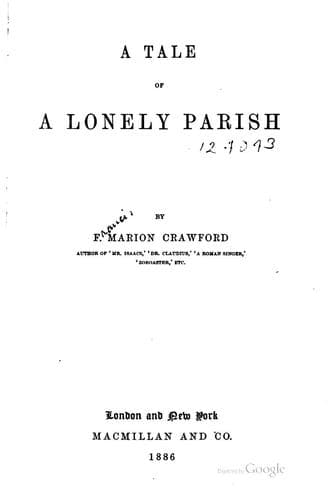
A Tale of a Lonely ParishCrawford, F. Marion (Francis Marion)
General
A Tale of a Lonely Parish
Crawford, F. Marion (Francis Marion)
Country life -- England -- Fiction; England -- Social life and customs -- Fiction
Mrs. Goddard was glad he was gone, though she felt that he was not
unsympathetic. The story of the dog had frightened her, and her own
mention of her husband had made her nervous and sad. More than ever she
felt that fear of being in a false position, which had assailed her when
she had first met the squire on the previous evening. He had at once
opened relations with her in a way which showed that he intended to be
intimate; he had offered to improve her cottage, had insisted upon making
frames in her garden, had asked her to dinner with the Ambroses and had
established the right to talk to her whenever he got a chance. He
interested her, too, which was worse. His passing references to his
travels and to his adventures, of which he spoke with the indifference
of a man accustomed to danger, his unassuming manner, his frank
ways--everything about him awakened her interest. She had supposed that
in two years the very faculty of being interested by a man would be
dulled if not destroyed; she found to her annoyance that though she had
seen Mr. Juxon only twice she could not put him out of her thoughts. She
was, moreover, a nervous, almost morbid, woman, and the natural result of
trying to forget his existence was that she could think of nothing else.
How much better it would be, she thought, if he knew her story from the
first. He might then be as friendly as he pleased; there would be no
danger in it, to him or to her. She almost determined to go at once and
ask the vicar's advice. But by the time she had nearly made up her mind
it was the hour for luncheon, and little Nellie's appetite was exigent.
By the time lunch was over her determination had changed. She had
reflected that the vicar would think her morbid, that, with his usual
good sense, he would say there was no necessity for telling the squire
anything; indeed, that to do so would be undignified. If the squire were
indeed going to lead the life of a recluse as he proposed doing, he was
not really a man to cause her any apprehension. If he had travelled about
the world for forty years, without having his heart disturbed by any of
the women he must have met in that time, he was certainly not the kind of
man, when once he had determined to settle in his home, to fall in love
with the first pretty woman he met. It was absurd; there was no
likelihood of it; it was her own miserable vanity, she told herself,
which made the thing seem probable, and she would not think any more
about it. She, a woman thirty-one years of age, with a daughter who ere
long would be growing up to womanhood! To be afraid of a mere stranger
like Mr. Juxon--afraid lest he should fall in love with her! Could
anything be more ridiculous? Her duty was to live quietly as she had
lived before, to take no more notice of the squire than was necessary in
order to be civil, and so all would be well.
Public-domain text, read in full here on John Shaqi.
Reviews
Reviews
No reviews yet
Be the first to share your thoughts on this work.
Join the Discussion
Join the discussion
Sign in to leave a comment or review.
Sign InorCreate an account