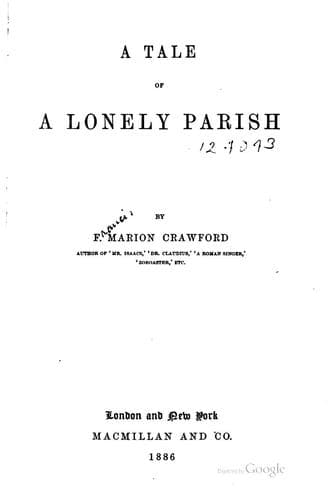
A Tale of a Lonely ParishCrawford, F. Marion (Francis Marion)
General
A Tale of a Lonely Parish
Crawford, F. Marion (Francis Marion)
Country life -- England -- Fiction; England -- Social life and customs -- Fiction
To chronicle the small events which occurred in that Arcadian parish,
would be to overstep the bounds of permissible tediousness. In such
places all events move slowly and take long to develop to their results.
The passions which in our own quickly moving world spring up, flourish,
wither and are cut down in a month require, when they are not stimulated
by the fertilising heat of artificial surroundings, a longer period for
their growth; and when that growth is attained they are likely to be
stronger and more deeply rooted. It is not true that the study of them is
less interesting, nor that they have less importance in themselves. The
difficulty of narrative is greater when they are to be described, for it
is necessary to carry the imagination in a short time over a long period,
to show how from small incidents great results follow, and to show also
how the very limited and trivial nature of the surroundings may cause
important things to be overlooked. Amidst such influences acquaintance is
soon made between the few persons so thrown together, but each is apt to
regard such new acquaintance merely as bearing upon his or her own
particular interests. It is surprising to see how people will live side
by side in solitude, even in danger, in distant settlements, in the
mining districts of the West, in up-country stations in India, on board
ship, even, for months and years, without knowing anything of each
other's previous history; whereas in the crowded centres of civilisation
and society the first questions are "Where does he come from?" "What are
his antecedents?" "What has he done in the world?" And unless a man can
answer such inquiries to the general satisfaction he is likely to be
heavily handicapped in the social race. But in more primitive situations
men are ruled by more primitive feelings of mutual respect; it is
considered that a man should not be pressed to speak of things he shows
no desire to discuss and that, provided he does not interfere with his
neighbour's wellbeing, his past life is nobody's business. One may feel
curiosity concerning him, but under no circumstances is one justified in
asking questions.
Public-domain text, read in full here on John Shaqi.
Reviews
Reviews
No reviews yet
Be the first to share your thoughts on this work.
Join the Discussion
Join the discussion
Sign in to leave a comment or review.
Sign InorCreate an account