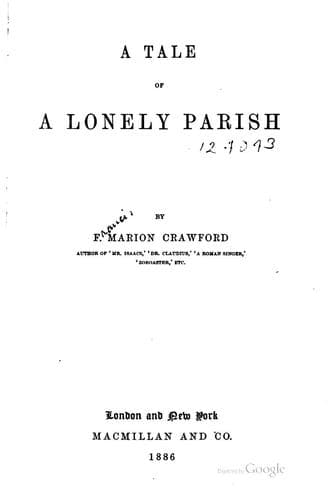
A Tale of a Lonely ParishCrawford, F. Marion (Francis Marion)
General
A Tale of a Lonely Parish
Crawford, F. Marion (Francis Marion)
Country life -- England -- Fiction; England -- Social life and customs -- Fiction
If Mr. Juxon was not in love with Mary Goddard he was at least rapidly
approaching a very dangerous state; for he saw her every day and could
not let one day go by without seeing her, and moreover he grew silent in
her company, to a degree which embarrassed her and made him feel himself
more stupid than he had ever dreamed possible; so that he would sometimes
stay too long, in the hope of finding something to say, and sometimes he
would leave her abruptly and go and shut himself up with his books, and
busy himself with his catalogues and his bindings and the arrangement of
his rare editions. One day at last, he felt that he had behaved so very
absurdly that he was ashamed of himself, and suddenly disappeared for
nearly a week. When he returned he said he had been to town to attend a
great sale of books, which was perfectly true; he did not add that the
learned expert he employed in London could have done the business for him
just as well. But the trip had done him no good, for he grew more silent
than ever, and Mrs. Goddard even thought his brown face looked a shade
paler; but that might have been the effect of the winter weather.
Ordinary sunburn she reflected, as she looked at her own white skin in
the mirror, will generally wear off in six months, though freckles will
not.
If Mr. Juxon was not in love, it would be very hard to say what Mary
Goddard felt. It was not true that time was effacing the memory of the
great sorrow she had suffered. It was there still, that memory, keen and
sharp as ever; it would never go away again so long as she lived. But she
had been soothed by the quiet life in Billingsfield; the evidences of the
past had been removed far from her, she had found in the Reverend
Augustin Ambrose one of those rare and manly natures who can keep a
secret for ever without ever referring to its existence even with the
person who has confided it. For a few days she had hesitated whether to
ask the vicar's advice about Mr. Juxon or not. She had thought it her
duty to allow Mr. Ambrose to tell the squire whatever he thought fit of
her own story. But she had changed her mind, and the squire had remained
in ignorance. It was best so, she thought; for now, after more than six
months, Mr. Juxon had taken the position of a friend towards her, and, as
she thought, showed no disposition whatever to overstep the boundaries of
friendship. The regularity of his visits and the sameness of the
conversation seemed of themselves a guarantee of his simple goodwill. It
did not strike her as possible that if he were going to fall in love with
her at all, that catastrophe should be postponed beyond six months from
their first acquaintance. Nor did it seem extraordinary to her that she
should actually look forward to those visits, and take pleasure in that
monotonous intercourse. Her life was very quiet; it was natural that she
should take whatever diversion came in her way, and should even be
thankful for it. Mr.
Public-domain text, read in full here on John Shaqi.
Reviews
Reviews
No reviews yet
Be the first to share your thoughts on this work.
Join the Discussion
Join the discussion
Sign in to leave a comment or review.
Sign InorCreate an account