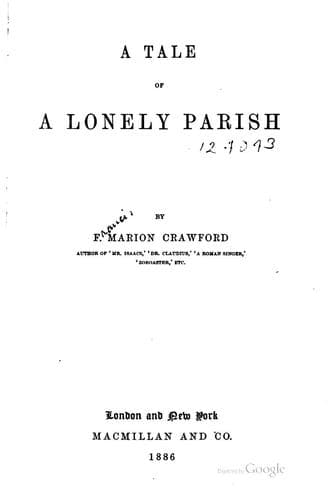
A Tale of a Lonely ParishCrawford, F. Marion (Francis Marion)
General
A Tale of a Lonely Parish
Crawford, F. Marion (Francis Marion)
Country life -- England -- Fiction; England -- Social life and customs -- Fiction
Indeed the squire had not shown himself to be so, on the whole, and he
did not refer to the matter again during the evening. He kept his place
for some time by Mrs. Goddard's side and then, judging that he had
sufficiently asserted his superiority, rose and talked to Mrs. Ambrose.
But John, being now in a thoroughly bad humour, could not take his vacant
seat with a good grace. He stood aloof and took up a book that lay upon
the table and avoided looking at Mrs. Goddard. By and by, when the party
broke up, he said good-night in such a particularly cold and formal tone
of voice that she stared at him in surprise. But he took no notice of her
look and went away after the Ambroses, in that state of mind which boys
call a huff.
But on the following day John repented of his behaviour. All day long he
wandered about the garden of the vicarage, excusing himself from joining
the daily skating which formed the staple of amusement during the
Christmas week, by saying that he had an idea for a copy of verses and
must needs work it out. But he inwardly hoped that Mrs. Goddard would
come to the vicarage late in the afternoon, without the inevitable Mr.
Juxon, and that he might then get a chance of talking to her. He was not
quite sure what he should say. He would find words on the spur of the
moment; it would at all events be much easier than to meet her on the ice
at the Hall with all the rest of them and to see Mr. Juxon pushing her
about in that detestable chair, with the unruffled air of superiority
which John so hated to see upon his face. The vicar suspected more than
ever that there was something wrong; he had seen some of the by-play on
the previous evening, and had noticed John's ill-concealed disappointment
at being unable to dislodge the sturdy squire from his seat. But Mrs.
Ambrose seemed to be very obtuse, and the vicar would have been the last
to have spoken of his suspicions, even to the wife of his bosom. It was
his duty to induce John to go back to his work at the end of the week; it
was not his duty to put imputations upon him which Mrs. Ambrose would
naturally exaggerate and which would drive her excellent heart into a
terrible state of nervous anxiety.
Public-domain text, read in full here on John Shaqi.
Reviews
Reviews
No reviews yet
Be the first to share your thoughts on this work.
Elsewhere in the archive
Join the Discussion
Join the discussion
Sign in to leave a comment or review.
Sign InorCreate an account