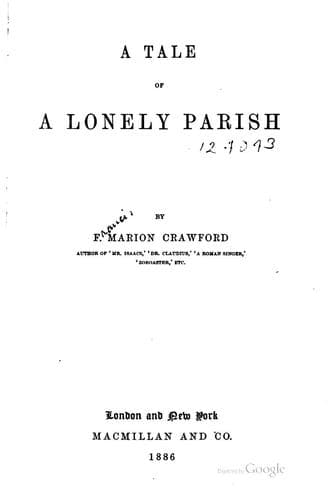
A Tale of a Lonely ParishCrawford, F. Marion (Francis Marion)
General
A Tale of a Lonely Parish
Crawford, F. Marion (Francis Marion)
Country life -- England -- Fiction; England -- Social life and customs -- Fiction
But Mrs. Goddard did not come back to the vicarage on that day, and John
went to dinner with a sad heart. It did not seem like a day at all if he
had not seen her and talked with her. He had now no doubt whatever that
he was seriously in love, and he set himself to consider his position.
The more he considered it, the more irreconcilable it seemed to be with
the passion which beset him. A child could see that for several years, at
least, he would not be in a position to marry. With Mr. Juxon at hand
from year's end to year's end, the owner of the Hall, of the
Billingsfield property and according to all appearances of other
resources besides,--with such a man constantly devoted to her, could Mrs.
Goddard be expected to wait for poor John three years, even two years,
from the time of the examination for the classical Tripos? Nothing was
more improbable, he was forced to admit. And yet, the idea of life if he
did not marry Mrs. Goddard was dismal beyond all expression; he would
probably not survive it. He did not know what he should do. He shrank
from the thought of declaring his love to her at once. He remembered with
pain that she had a terrible way of laughing at him when he grew
confidential or too complimentary, and he dreaded lest at the supreme
moment of his life he should appear ridiculous in her eyes--he, a mere
undergraduate. If he came out at the head of the Tripos it would be
different; and yet that seemed so long to wait, especially while Mr.
Juxon lived at the Hall and Mrs. Goddard lived at the park gates.
Suddenly a thought struck him which filled him with delight; it was just
possible that Mr. Juxon had no intention of marrying Mrs. Goddard. If he
had any such views he would probably have declared them before now, for
he had met her every day during more than half a year. John longed to ask
some one the question. Perhaps Mr. Ambrose, who might be supposed to know
everything connected with Mrs. Goddard, could tell him. He felt very
nervous at the idea of speaking to the vicar on the subject, and yet it
seemed to him that no one else could set his mind at rest. If he were
quite certain that Mr. Juxon had no intention of offering himself to the
charming tenant of the cottage, he might return to his work with some
sense of security in the future. Otherwise he saw only the desperate
alternative of throwing himself at her feet and declaring that he loved
her, or of going back to Cambridge with the dreadful anticipation of
hearing any day that she had married the squire. To be laughed at would
be bad, but to feel that he had lost her irrevocably, without a struggle,
would be awful. No one but the vicar could and would tell him the truth;
it would be bitter to ask such a question, but it must be done. Having at
last come to this formidable resolution, towards the conclusion of
dinner, his spirits rose a little. He took another glass of the vicar's
mild ale and felt that he could face his fate.
Public-domain text, read in full here on John Shaqi.
Reviews
Reviews
No reviews yet
Be the first to share your thoughts on this work.
Elsewhere in the archive
Join the Discussion
Join the discussion
Sign in to leave a comment or review.
Sign InorCreate an account