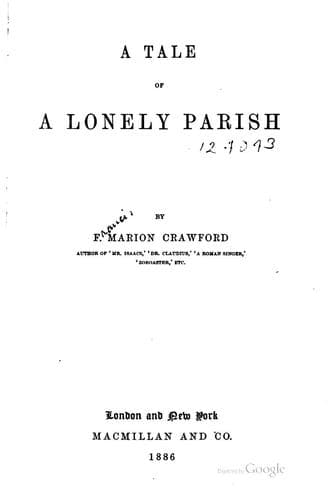
A Tale of a Lonely ParishCrawford, F. Marion (Francis Marion)
General
A Tale of a Lonely Parish
Crawford, F. Marion (Francis Marion)
Country life -- England -- Fiction; England -- Social life and customs -- Fiction
The vicar's suspicions were more than realized and he passed an
uncomfortable day after his interview with John, in debating what he
ought to do, whether he ought to do anything at all, or whether he should
merely hasten his old pupil's departure and leave matters to take care of
themselves. He was a very conscientious man, and he felt that he was
responsible for John's conduct towards Mrs. Goddard, seeing that she had
put herself under his protection, and that John was almost like one of
his family. His first impulse was to ask counsel of his wife, but he
rejected the plan, reflecting with great justice that she was very fond
of John and had at first not been sure of liking Mrs. Goddard; she would
be capable of thinking that the latter had "led Short on," as she would
probably say. The vicar did not believe this, and was therefore loath
that any one else should. He felt that circumstances had made him Mrs.
Goddard's protector, and he was moreover personally attached to her; he
would not therefore do or say anything whereby she was likely to
appear to any one else in an unfavourable light. It was incredible that
she should have given John any real encouragement. Mr. Ambrose wondered
whether he ought to warn her of his pupil's madness. But when he thought
about that, it seemed unnecessary. It was unlikely that John would betray
himself during his present visit, since the vicar had solemnly assured
him that there was no possibility of a marriage so far as Mr. Juxon was
concerned. It was undoubtedly a very uncomfortable situation but there
was evidently nothing to be done; Mr. Ambrose felt that to speak to Mrs.
Goddard would be to precipitate matters in a way which could not but
cause much humiliation to John Short and much annoyance to herself. He
accordingly held his peace, but his upper lip set itself stiffly and his
eyes had a combative expression which told his wife that there was
something the matter.
After breakfast John went out, on pretence of walking in the garden, and
Mr. and Mrs. Ambrose were left alone. The latter, as usual after the
morning meal, busied herself about the room, searching out those secret
corners which she suspected Susan of having forgotten to dust. The vicar
stood looking out of the window. The weather was grey and it seemed
likely that there would be a thaw which would spoil the skating.
"I think," said Mrs. Ambrose, "that John is far from well."
"What makes you say that?" inquired the vicar, who was thinking of him at
that very moment.
"Anybody might see it. He has no appetite--he ate nothing at breakfast
this morning. He looks pale. My dear, that boy will certainly break
down."
"I don't believe it," answered Mr. Ambrose still looking out of the
window. His hands were in his pockets, thrusting the skirts of his
clerical coat to right and left; he slowly raised himself upon his toes
and let himself down again, repeating the operation as though it helped
him to think.
Public-domain text, read in full here on John Shaqi.
Reviews
Reviews
No reviews yet
Be the first to share your thoughts on this work.
Elsewhere in the archive
Join the Discussion
Join the discussion
Sign in to leave a comment or review.
Sign InorCreate an account