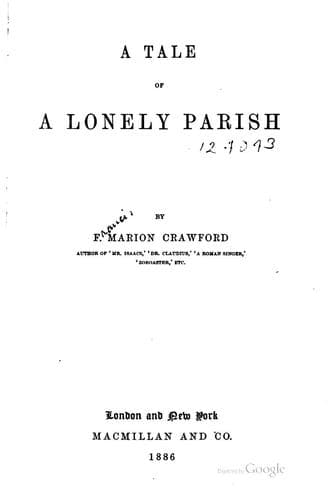
A Tale of a Lonely ParishCrawford, F. Marion (Francis Marion)
General
A Tale of a Lonely Parish
Crawford, F. Marion (Francis Marion)
Country life -- England -- Fiction; England -- Social life and customs -- Fiction
"That is the way you spoil all your coats, Augustin," said his wife
looking at him from behind. "I assure you, my dear, that boy is not well.
Poor fellow, all alone at college with nobody to look after him--"
"We have all had to go through that. I do not think it hurts him a bit,"
said the vicar, slowly removing his hands from his pockets in deference
to his wife's suggestion.
"Then what is it, I would like to know? There is certainly something the
matter. Now I ask you whether he looks like himself?"
"Perhaps he does look a little tired."
"Tired! There is something on his mind, Augustin. I am positively certain
there is something on his mind. Why won't you tell me?"
"My dear--" began the vicar, and then stopped short. He was a very
truthful man, and as he knew very well what was the matter with John he
was embarrassed to find an answer. "My dear," he repeated, "I do not
think he is ill."
"Then I am right," retorted Mrs. Ambrose, triumphantly. "It is just as I
thought, there is something on his mind. Don't deny it, Augustin; there
is something on his mind."
Mr. Ambrose was silent; he glared fiercely at the window panes.
"Why don't you tell me?" insisted his better half. "I am quite sure you
know all about it. Augustin, do you know, or do you not?"
Thus directly questioned the vicar turned sharply round, sweeping the
window with his coat tails.
"My dear," he said, shortly, "I do know. Can you not imagine that it may
be a matter which John does not care to have mentioned?"
Mrs. Ambrose grew red with annoyance. She had set her heart on finding
out what had disturbed John, and the vicar had apparently made up his
mind that she should not succeed. Such occurrences were very rare between
that happy couple.
"I cannot believe he has done anything wrong," said Mrs. Ambrose.
"Anything which need be concealed from me--the interest I have always
taken--"
"He has not done anything wrong," said the vicar impatiently. "I do wish
you would drop the subject--"
"Then why should it be concealed from me?" objected his wife with
admirable logic. "If it is anything good he need not hide his light under
a bushel, I should think."
"There are plenty of things which are neither bad nor good," argued the
vicar, who felt that if he could draw Mrs. Ambrose into a Socratic
discussion he was safe.
"That is a distinct prevarication, Augustin," said she severely. "I am
surprised at you."
"Not at all," retorted the vicar. "What has occurred to John is not owing
to any fault of his." In his own mind the good man excused himself by
saying that John could not have helped falling in love with Mrs. Goddard.
But his wife turned quickly upon him.
"That does not prevent what has occurred to him, as you call it, from
being good, or more likely bad, to judge from his looks."
"My dear," said Mr. Ambrose, driven to bay, "I entirely decline to
discuss the point."
"I thought you trusted me, Augustin."
"So I do--certainly--and I always consult you about my own affairs."
Public-domain text, read in full here on John Shaqi.
Reviews
Reviews
No reviews yet
Be the first to share your thoughts on this work.
Elsewhere in the archive
Join the Discussion
Join the discussion
Sign in to leave a comment or review.
Sign InorCreate an account