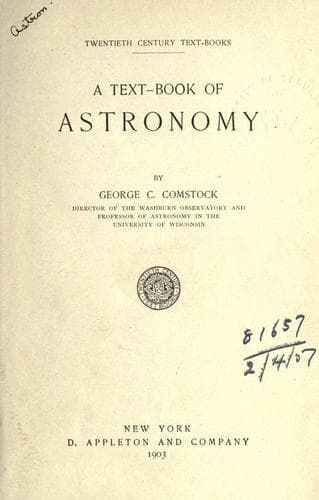
A Text-Book of AstronomyComstock, George C. (George Cary)
Science
A Text-Book of Astronomy
Comstock, George C. (George Cary)
Astronomy
Some of the common terrestrial elements found in the sun are:
Aluminium.
Calcium.
Carbon.
Copper.
Hydrogen.
Iron.
Lead.
Nickel.
Potassium.
Silicon.
Silver.
Sodium.
Tin.
Zinc.
Oxygen (?)
Whatever differences of chemical structure may exist between the sun and
the earth, it seems that we must regard these bodies as more like than
unlike to each other in substance, and we are brought back to the second
of our alternatives: there must be some influence opposing the force of
gravity and making the substance of the sun light instead of heavy, and
we need not seek far to find it in--
117. THE HEAT OF THE SUN.--That the sun is hot is too evident to require
proof, and it is a familiar fact that heat expands most substances and
makes them less dense. The sun's heat falling upon the earth expands it
and diminishes its density in some small degree, and we have only to
imagine this process of expansion continued until the earth's diameter
becomes 58 per cent larger than it now is, to find the earth's density
reduced to a level with that of the sun. Just how much the temperature
of the earth must be raised to produce this amount of expansion we do
not know, neither do we know accurately the temperature of the sun, but
there can be no doubt that heat is the cause of the sun's low density
and that the corresponding temperature is very high.
Before we inquire more closely into the sun's temperature, it will be
well to draw a sharp distinction between the two terms heat and
temperature, which are often used as if they meant the same thing. Heat
is a form of energy which may be found in varying degree in every
substance, whether warm or cold--a block of ice contains a considerable
amount of heat--while temperature corresponds to our sensations of warm
and cold, and measures the extent to which heat is concentrated in the
body. It is the amount of heat per molecule of the body. A barrel of
warm water contains more heat than the flame of a match, but its
temperature is not so high. Bearing in mind this distinction, we seek to
determine not the amount of heat contained in the sun but the sun's
temperature, and this involves the same difficulty as does the question,
What is the temperature of a locomotive? It is one thing in the fire box
and another thing in the driving wheels, and still another at the
headlight; and so with the sun, its temperature is certainly different
in different parts--one thing at the center and another at the surface.
Even those parts which we see are covered by a veil of gases which
produce by absorption the dark lines of the solar spectrum, and
seriously interfere both with the emission of energy from the sun and
with our attempts at measuring the temperature of those parts of the
surface from which that energy streams.
Public-domain text, read in full here on John Shaqi.
Reviews
Reviews
No reviews yet
Be the first to share your thoughts on this work.
Elsewhere in the archive
Join the Discussion
Join the discussion
Sign in to leave a comment or review.
Sign InorCreate an account