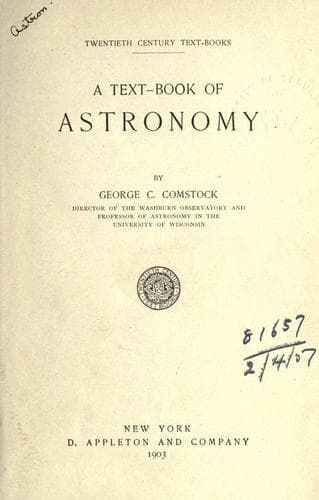
A Text-Book of AstronomyComstock, George C. (George Cary)
Science
A Text-Book of Astronomy
Comstock, George C. (George Cary)
Astronomy
In view of these and other difficulties we need not be surprised that
the wildest discordance has been found in estimates of the solar
temperature made by different investigators, who have assigned to it
values ranging from 1,400° C. to more than 5,000,000° C. Quite recently,
however, improved methods and a better understanding of the problem have
brought about a better agreement of results, and it now seems probable
that the temperature of the visible surface of the sun lies somewhere
between 5,000° and 10,000° C., say 15,000° of the Fahrenheit scale.
118. DETERMINING THE SUN'S TEMPERATURE.--One ingenious method which has
been used for determining this temperature is based upon the principle
stated above, that every object, whether warm or cold, contains heat and
gives it off in the form of radiant energy. The radiation from a body
whose temperature is lower than 500° C. is made up exclusively of energy
whose wave length is greater than 7,600 tenth meters, and is therefore
invisible to the eye, although a thermometer or even the human hand can
often detect it as radiant heat. A brick wall in the summer sunshine
gives off energy which can be felt as heat but can not be seen. When
such a body is further heated it continues to send off the same kinds
(wave lengths) of energy as before, but new and shorter waves are added
to its radiation, and when it begins to emit energy of wave length 7,500
or 7,600 tenth meters, it also begins to shine with a dull-red light,
which presently becomes brighter and less ruddy and changes to white as
the temperature rises, and waves of still shorter length are thereby
added to the radiation. We say, in common speech, the body becomes first
red hot and then white hot, and we thus recognize in a general way that
the kind or color of the radiation which a body gives off is an index to
its temperature. The greater the proportion of energy of short wave
lengths the higher is the temperature of the radiating body. In sunlight
the maximum of brilliancy to the eye lies at or near the wave length,
5,600 tenth meters, but the greatest intensity of radiation of all kinds
(light included) is estimated to fall somewhere between green and blue
in the spectrum at or near the wave length 5,000 tenth meters, and if we
can apply to this wave length Paschen's law--temperature reckoned in
degrees centigrade from the absolute zero is always equal to the
quotient obtained by dividing the number 27,000,000 by the wave length
corresponding to maximum radiation--we shall find at once for the
absolute temperature of the sun's surface 5,400° C.
Paschen's law has been shown to hold true, at least approximately, for
lower temperatures and longer wave lengths than are here involved, but
as it is not yet certain that it is strictly true and holds for all
temperatures, too great reliance must not be attached to the numerical
result furnished by it.
[Illustration: FIG. 66.--The sun, August 11, 1894. Photographed at the
Goodsell Observatory.]
Public-domain text, read in full here on John Shaqi.
Reviews
Reviews
No reviews yet
Be the first to share your thoughts on this work.
Elsewhere in the archive
Join the Discussion
Join the discussion
Sign in to leave a comment or review.
Sign InorCreate an account