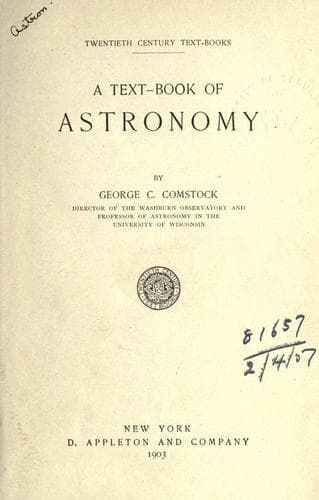
A Text-Book of AstronomyComstock, George C. (George Cary)
Science
A Text-Book of Astronomy
Comstock, George C. (George Cary)
Astronomy
Every boy who has inflated a bicycle tire with a hand pump knows that
the pump grows warm during the operation, on account of the compression
of the air within the cylinder. A part of the muscular force (energy)
expended in working the pump reappears in the heat which warms both air
and pump, and a similar process is forever going on in the sun, only in
place of muscular force we must there substitute the tremendous
attraction of gravitation, 28 times as great as upon the earth. "The
matter in the interior of the sun must be as a shuttlecock between the
stupendous pressure and the enormously high temperature," the one
tending to compress and the other to expand it, but with this important
difference between them: the temperature steadily tends to fall as the
heat energy is wasted away, while the gravitative force suffers no
corresponding diminution, and in the long run must gain the upper hand,
causing the sun to shrink and become more dense. It is this progressive
shrinking and compression of its molecules into a smaller space which
supplies the energy contained in the sun's output of light and heat.
According to Lord Kelvin, each centimeter of shrinkage in the sun's
diameter furnishes the energy required to keep up its radiation for
something more than an hour, and, on account of the sun's great
distance, the shrinkage might go on at this rate for many centuries
without producing any measurable effect in the sun's appearance.
127. GASEOUS CONSTITUTION OF THE SUN.--But Helmholtz's dynamical theory
of the maintenance of the sun's heat, which we are here considering,
includes one essential feature that is not sufficiently stated above. In
order that the explanation may hold true, it is necessary that the sun
should be in the main a gaseous body, composed from center to
circumference of gases instead of solid or liquid parts. Pumping air
warms the bicycle pump in a way that pumping water or oil will not.
The high temperature of the sun itself furnishes sufficient reason for
supposing the solar material to be in the gaseous state, but the gas
composing those parts of the sun below the photosphere must be very
different in some of its characteristics from the air or other gases
with which we are familiar at the earth, since its average density is
1,000 times as great as that of air, and its consistence and mechanical
behavior must be more like that of honey or tar than that of any gas
with which we are familiar. It is worth noting, however, that if a hole
were dug into the crust of the earth to a depth of 15 or 20 miles the
air at the bottom of the hole would be compressed by that above it to a
density comparable with that of the solar gases.
Public-domain text, read in full here on John Shaqi.
Reviews
Reviews
No reviews yet
Be the first to share your thoughts on this work.
Elsewhere in the archive
Join the Discussion
Join the discussion
Sign in to leave a comment or review.
Sign InorCreate an account