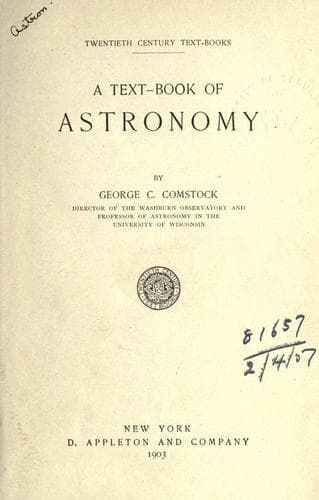
A Text-Book of AstronomyComstock, George C. (George Cary)
Science
A Text-Book of Astronomy
Comstock, George C. (George Cary)
Astronomy
128. THE SUN'S CIRCULATION.--It is plain that under the conditions which
exist in the sun the outer portions, which can radiate their heat freely
into space, must be cooler than the inner central parts, and this
difference of temperature must set up currents of hot matter drifting
upward and outward from within the sun and counter currents of cooler
matter settling down to take its place. So, too, there must be some
level at which the free radiation into outer space chills the hot matter
sufficiently to condense its less refractory gases into clouds made up
of liquid drops, just as on a cloudy day there is a level in our own
atmosphere at which the vapor of water condenses into liquid drops which
form the thin shell of clouds that hovers above the earth's surface,
while above and below is the gaseous atmosphere. In the case of the sun
this cloud layer is always present and is that part which we have
learned to call the photosphere. Above the photosphere lies the
chromosphere, composed of gases less easily liquefied, hydrogen is the
chief one, while between photosphere and chromosphere is a thin layer of
metallic vapors, perhaps indistinguishable from the top crust of the
photosphere itself, which by absorbing the light given off from the
liquid photosphere produces the greater part of the Fraunhofer lines in
the solar spectrum.
From time to time the hot matter struggling up from below breaks through
the photosphere and, carrying with it a certain amount of the metallic
vapors, is launched into the upper and cooler regions of the sun,
where, parting with its heat, it falls back again upon the photosphere
and is absorbed into it. It is altogether probable that the corona is
chiefly composed of fine particles ejected from the sun with velocities
sufficient to carry them to a height of millions of miles, or even
sufficient to carry them off never to return. The matter of the corona
must certainly be in a state of the most lively agitation, its particles
being alternately hurled up from the photosphere and falling back again
like fireworks, the particles which make up the corona of to-day being
quite a different set from those of yesterday or last week. It seems
beyond question that the prominences and faculæ too are produced in some
way by this up-and-down circulation of the sun's matter, and that any
mechanical explanation of the sun must be worked out along these lines;
but the problem is an exceedingly difficult one, and must include and
explain many other features of the sun's activity of which only a few
can be considered here.
Public-domain text, read in full here on John Shaqi.
Reviews
Reviews
No reviews yet
Be the first to share your thoughts on this work.
Elsewhere in the archive
Join the Discussion
Join the discussion
Sign in to leave a comment or review.
Sign InorCreate an account