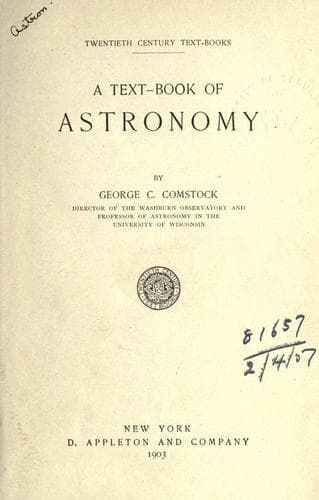
A Text-Book of AstronomyComstock, George C. (George Cary)
Science
A Text-Book of Astronomy
Comstock, George C. (George Cary)
Astronomy
For nearly three centuries (1610 to 1892) astronomers spoke of the four
satellites of Jupiter; but in September, 1892, a fifth one was added to
the number by Professor Barnard, who, observing with the largest
telescope then extant, found very close to Jupiter a tiny object only
1/600 part as bright as the other satellites, but, like them, revolving
around Jupiter, a permanent member of his system. This is called the
fifth satellite, and Fig. 89 shows the orbits of these satellites around
Jupiter, which is here represented on the same scale as the orbits
themselves. The broken line just inside the orbit of I represents the
size of the moon's orbit. The cut shows also the periodic times of the
satellites expressed in days, and furnishes in this respect a striking
illustration of the great mass of Jupiter. Satellite I is a little
farther from Jupiter than is the moon from the earth, but under the
influence of a greater attraction it makes the circuit of its orbit in
1.77 days, instead of taking 29.53 days, as does the moon. Determine
from the figure by the method employed in § 111 how much more massive is
Jupiter than the earth.
Small as these satellites seem in Fig. 86, they are really bodies of
considerable size, as appears from Fig. 90, where their dimensions are
compared with those of the earth and moon, save that the fifth satellite
is not included. This one is so small as to escape all attempts at
measuring its diameter, but, judging from the amount of light it
reflects, the period printed with the legend of the figure represents a
gross exaggeration of this satellite's size.
[Illustration: FIG. 90.--Jupiter's satellites compared with the earth
and moon.]
Like the moon, each of these satellites may fairly be considered a world
in itself, and as such a fitting object of detailed study, but,
unfortunately, their great distance from us makes it impossible, even
with the most powerful telescope, to see more upon their surfaces than
occasional vague markings, which hardly suffice to show the rotations of
the satellites upon their axes.
Public-domain text, read in full here on John Shaqi.
Reviews
Reviews
No reviews yet
Be the first to share your thoughts on this work.
Elsewhere in the archive
Join the Discussion
Join the discussion
Sign in to leave a comment or review.
Sign InorCreate an account