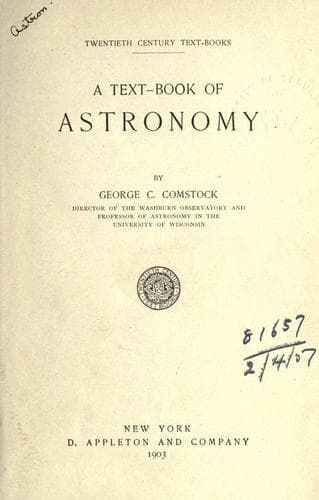
A Text-Book of AstronomyComstock, George C. (George Cary)
Science
A Text-Book of Astronomy
Comstock, George C. (George Cary)
Astronomy
One striking feature, however, comes out from a study of their influence
in disturbing each other's motion about Jupiter. Their masses and the
resulting densities of the satellites are smaller than we should have
expected to find, the density being less than that of the moon, and
averaging only a little greater than the density of Jupiter itself. At
the surface of the third satellite the force of gravity is but little
less than on the moon, although the moon's density is nearly twice as
great as that of III, and there can be no question here of accounting
for the low density through expansion by great heat, as in the case of
the sun and Jupiter. It has been surmised that these satellites are not
solid bodies, like the earth and moon, but only shoals of rock and
stone, loosely piled together and kept from packing into a solid mass by
the action of Jupiter in raising tides within them. But the explanation
can hardly be regarded as an accepted article of astronomical belief,
although it is supported by some observations which tend to show that
the apparent shapes of the satellites change under the influence of the
tidal forces impressed upon them.
141. ECLIPSES OF THE SATELLITES.--It may be seen from Fig. 89 that in
their motion around the planet Jupiter's satellites must from time to
time pass through his shadow and be eclipsed, and that the shadows of
the satellites will occasionally fall upon the planet, producing to an
observer upon Jupiter an eclipse of the sun, but to an observer on the
earth presenting only the appearance of a round black spot moving slowly
across the face of the planet. Occasionally also a satellite will pass
exactly between the earth and Jupiter, and may be seen projected against
the planet as a background. All of these phenomena are duly predicted
and observed by astronomers, but the eclipses are the only ones we need
consider here. The importance of these eclipses was early recognized,
and astronomers endeavored to construct a theory of their recurrence
which would permit accurate predictions of them to be made. But in this
they met with no great success, for while it was easy enough to foretell
on what night an eclipse of a given satellite would occur, and even to
assign the hour of the night, it was not possible to make the predicted
minute agree with the actual time of eclipse until after Roemer, a
Danish astronomer of the seventeenth century, found where lay the
trouble. His discovery was, that whenever the earth was on the side of
its orbit toward Jupiter the eclipses really occurred before the
predicted time, and when the earth was on the far side of its orbit they
came a few minutes later than the predicted time. He correctly inferred
that this was to be explained, not by any influence which the earth
exerted upon Jupiter and his satellites, but through the fact that the
light by which we see the satellite and its eclipse requires an
appreciable time to cross the intervening space, and a longer time when
Public-domain text, read in full here on John Shaqi.
Reviews
Reviews
No reviews yet
Be the first to share your thoughts on this work.
Elsewhere in the archive
Join the Discussion
Join the discussion
Sign in to leave a comment or review.
Sign InorCreate an account