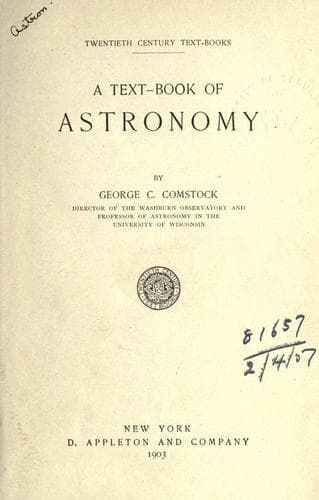
A Text-Book of AstronomyComstock, George C. (George Cary)
Science
A Text-Book of Astronomy
Comstock, George C. (George Cary)
Astronomy
After you have determined your latitude from Polaris, compare the result
with your position as shown upon the best map available. With a little
practice and considerable care the latitude may be thus determined
within one tenth of a degree, which is equivalent to about 7 miles. If
you go 10 miles north or south from your first station you should find
the pole higher up or lower down in the sky by an amount which can be
measured with your apparatus.
19. THE MERIDIAN LINE.--To establish a true north and south line upon
the ground, use the apparatus as described at page 13, and when Polaris
is at upper or lower culmination drive into the ground two stakes in
line with the star and the plumb line. Such a meridian line is of great
convenience in observing the stars and should be laid out and
permanently marked in some convenient open space from which, if
possible, all parts of the sky are visible. June and November are
convenient months for this exercise, since Polaris then comes to
culmination early in the evening.
20. TIME.--What is _the time_ at which school begins in the morning?
What do you mean by "_the time_"?
The sidereal time at any moment is the right ascension of the hour
circle which at that moment coincides with the meridian. When the hour
circle passing through Sirius coincides with the meridian, the sidereal
time is 6h. 40m., since that is the right ascension of Sirius, and in
astronomical language Sirius is "_on the meridian_" at 6h. 40m. sidereal
time. As may be seen from the map, this 6h. 40m. is the right ascension
of Sirius, and if a clock be set to indicate 6h. 40m. when Sirius
crosses the meridian, it will show sidereal time. If the clock is
properly regulated, every other star in the heavens will come to the
meridian at the moment when the time shown by the clock is equal to the
right ascension of the star. A clock properly regulated for this purpose
will gain about four minutes per day in comparison with ordinary clocks,
and when so regulated it is called a sidereal clock. The student should
be provided with such a clock for his future work, but one such clock
will serve for several persons, and a nutmeg clock or a watch of the
cheapest kind is quite sufficient.
[Illustration: THE HARVARD COLLEGE OBSERVATORY, CAMBRIDGE, MASS.]
Public-domain text, read in full here on John Shaqi.
Reviews
Reviews
No reviews yet
Be the first to share your thoughts on this work.
Join the Discussion
Join the discussion
Sign in to leave a comment or review.
Sign InorCreate an account