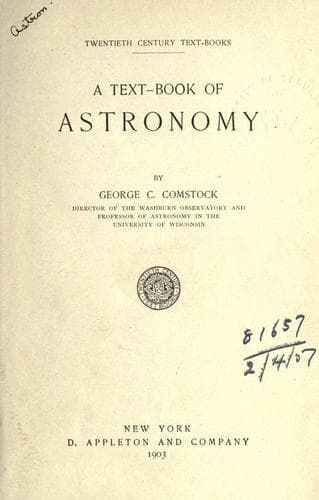
A Text-Book of AstronomyComstock, George C. (George Cary)
Science
A Text-Book of Astronomy
Comstock, George C. (George Cary)
Astronomy
A third-magnitude star is on the average twice as far away as one of the
first magnitude, a fifth-magnitude star four times as far off, etc.,
each additional two magnitudes doubling the average distance of the
stars, at least down to the eighth magnitude and possibly farther,
although beyond this limit we have no certain knowledge. Put in another
way, the naked eye sees many Sirian stars which _may_ have "gone out"
and ceased to shine centuries ago, for the light by which we now see
them left those stars before the discovery of America by Columbus. For
the student of mathematical tastes we note that the results of Kapteyn's
investigation of the mean distances (_D_) of the stars of magnitude
(_m_) may be put into two equations:
For Solar Stars, D = 23 × 2^{m/2}
For Sirian Stars, D = 52 × 2^{m/2}
where the coefficients 23 and 52 are expressed in light years. How long
a time is required for light to come from an average solar star of the
sixth magnitude?
197. CONSEQUENCES OF STELLAR DISTANCE.--The amount of light which comes
to us from any luminous body varies inversely as the square of its
distance, and since many of the stars are changing their distance from
us quite rapidly, it must be that with the lapse of time they will grow
brighter or fainter by reason of this altered distance. But the
distances themselves are so great that the most rapid known motion in
the line of sight would require more than 1,000 years (probably several
thousand) to produce any perceptible change in brilliancy.
The law in accordance with which this change of brilliancy takes place
is that the distance must be increased or diminished tenfold in order to
produce a change of five magnitudes in the brightness of the object, and
we may apply this law to determine the sun's rank among the stars. If it
were removed to the distance of an average first-, or second-, or
third-magnitude star, how would its light compare with that of the
stars? The average distance of a third-magnitude star of the solar type
is, as we have seen above, 4,000,000 times the sun's distance from the
earth, and since 4,000,000 = 10^{6.6}, we find that at this distance the
sun's stellar magnitude would be altered by 6.6 × 5 magnitudes, and
would therefore be -26.5 + 33.0 = 6.5--i. e., the sun if removed to the
average distance of the third-magnitude stars of its type would be
reduced to the very limit of naked-eye visibility. It must therefore be
relatively small and feeble as compared with the brightness of the
average star. It is only its close proximity to us that makes the sun
look brighter than the stars.
Public-domain text, read in full here on John Shaqi.
Reviews
Reviews
No reviews yet
Be the first to share your thoughts on this work.
Elsewhere in the archive
Join the Discussion
Join the discussion
Sign in to leave a comment or review.
Sign InorCreate an account