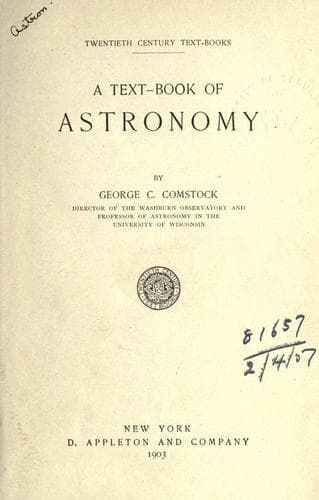
A Text-Book of AstronomyComstock, George C. (George Cary)
Science
A Text-Book of Astronomy
Comstock, George C. (George Cary)
Astronomy
The fixed stars may have planets circling around them, but an
application of the same principles will show how hopeless is the
prospect of ever seeing them in a telescope. If the sun's nearest
neighbor, α Centauri, were attended by a planet like Jupiter, this
planet would furnish to us no more light than does a star of the
twenty-second magnitude--i. e., it would be absolutely invisible, and
would remain invisible in the most powerful telescope yet built, even
though its bulk were increased to equal that of the sun. Let the student
make the computation leading to this result, assuming the stellar
magnitude of Jupiter to be -1.7.
198. DOUBLE STARS.--In the constellation Taurus, not far from Aldebaran,
is the fourth-magnitude star θ Tauri, which can readily be seen to
consist of two stars close together. The star α Capricorni is plainly
double, and a sharp eye can detect that one of the faint stars which
with Vega make a small equilateral triangle, is also a double star.
Look for them in the sky.
In the strict language of astronomy the term double star would not be
applied to the first two of these objects, since it is usually
restricted to those stars whose angular distance from each other is so
small that in the telescope they appear much as do the stars named above
to the naked eye--i. e., their angular separation is measured by a few
seconds or fractions of a single second, instead of the six minutes
which separate the component stars of θ Tauri or α Capricorni. There are
found in the sky many thousands of these close double stars, of which
some are only optically double--i. e., two stars nearly on line with the
earth but at very different distances from it--while more of them are
really what they seem, stars near each other, and in many cases near
enough to influence each other's motion. These are called _binary_
systems, and in cases of this kind the principles of celestial mechanics
set forth in Chapter IV hold true, and we may expect to find each
component of a double star moving in a conic section of some kind,
having its focus at the common center of gravity of the two stars.
We are thus presented with problems of orbital motion quite similar
to those which occur in the solar system, and careful telescopic
observations are required year after year to fix the relative positions
of the two stars--i. e., their angular separation, which it is customary
to call their _distance_, and their direction one from the other, which
is called _position angle_.
Public-domain text, read in full here on John Shaqi.
Reviews
Reviews
No reviews yet
Be the first to share your thoughts on this work.
Elsewhere in the archive
Join the Discussion
Join the discussion
Sign in to leave a comment or review.
Sign InorCreate an account