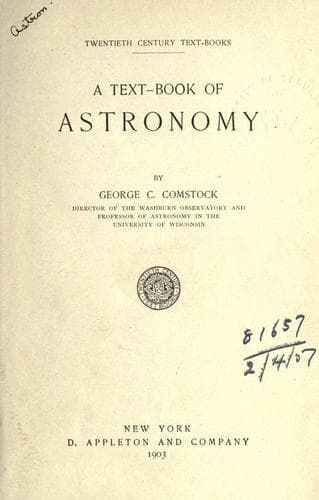
A Text-Book of AstronomyComstock, George C. (George Cary)
Science
A Text-Book of Astronomy
Comstock, George C. (George Cary)
Astronomy
225. ABSORPTION OF STARLIGHT.--We have had abundant occasion to learn
that at least within the confines of the solar system meteoric matter,
cosmic dust, is profusely scattered, and it appears not improbable that
the same is true, although in smaller degree, in even the remoter parts
of space. In this case the light which comes from the farther stars over
a path requiring many centuries to travel, must be in some measure
absorbed and enfeebled by the obstacles which it encounters on the way.
Unless celestial space is transparent to an improbable degree the
remoter stars do not show their true brightness; there is a certain
limit beyond which no star is able to send its light, and beyond which
the universe must be to us a blank. A lighthouse throws into the fog its
beams only to have them extinguished before a single mile is passed, and
though the celestial lights shine farther, a limit to their reach is
none the less certain if meteoric dust exists outside the solar system.
If there is such an absorption of light in space, as seems plausible,
the universe may well be limitless and the number of stellar systems
infinite, although the most attenuated of dust clouds suffices to
conceal from us and to shut off from our investigation all save a minor
fraction of it and them.
CHAPTER XV
GROWTH AND DECAY
226. NATURE OF THE PROBLEM.--To use a common figure of speech, the
universe is alive. We have found it filled with an activity that
manifests itself not only in the motions of the heavenly bodies along
their orbits, but which extends to their minutest parts, the molecules
and atoms, whose vibrations furnish the radiant energy given off by sun
and stars. Some of these activities, such as the motions of the heavenly
bodies in their orbits, seem fitted to be of endless duration; while
others, like the radiation of light and heat, are surely temporary, and
sooner or later must come to an end and be replaced by something
different. The study of things as they are thus leads inevitably to
questions of what has been and what is to be. A sound science should
furnish some account of the universe of yesterday and to-morrow as well
as of to-day, and we need not shrink from such questions, although
answers to them must be vague and in great measure speculative.
Public-domain text, read in full here on John Shaqi.
Reviews
Reviews
No reviews yet
Be the first to share your thoughts on this work.
Elsewhere in the archive
Join the Discussion
Join the discussion
Sign in to leave a comment or review.
Sign InorCreate an account