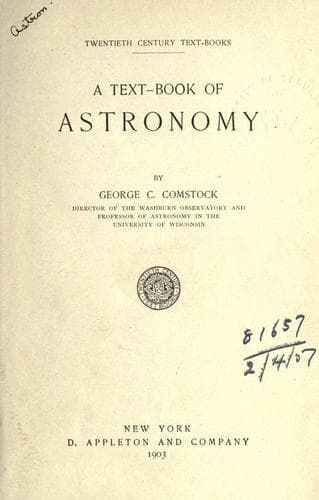
A Text-Book of AstronomyComstock, George C. (George Cary)
Science
A Text-Book of Astronomy
Comstock, George C. (George Cary)
Astronomy
The historian of America finds little difficulty with events of the
nineteenth century or even the eighteenth, but the sources of
information about America in the fifteenth century are much less
definite; the tenth century presents almost a blank, and the history of
American mankind in the first century of the Christian era is wholly
unknown. So, as we attempt to look into the past or the future of the
heavens, we must expect to find the mists of obscurity grow denser with
remoter periods until even the vaguest outlines of its development are
lost, and we are compelled to say, beyond this lies the unknown. Our
account of growth and decay in the universe, therefore, can not aspire
to cover the whole duration of things, but must be limited in its scope
to certain chapters whose epochs lie near to the time in which we live,
and even for these we need to bear constantly in mind the logical bases
of such an inquiry and the limitations which they impose upon us.
227. LOGICAL BASES AND LIMITATIONS.--The first of these bases is: An
adequate knowledge of the present universe. Our only hope of reading the
past and future lies in an understanding of the present; not necessarily
a complete knowledge of it, but one which is sound so far as it goes.
Our position is like that of a detective who is called upon to unravel a
mystery or crime, and who must commence with the traces that have been
left behind in its commission. The foot print, the blood stain, the
broken glass must be examined and compared, and fashioned into a theory
of how they came to be; and as a wrong understanding of these elements
is sure to vitiate the theories based upon them, so a false science of
the universe as it now is, will surely give a false account of what it
has been; while a correct but incomplete knowledge of the present does
not wholly bar an understanding of the past, but only puts us in the
position of the detective who correctly understands what he sees but
fails to take note of other facts which might greatly aid him.
Public-domain text, read in full here on John Shaqi.
Reviews
Reviews
No reviews yet
Be the first to share your thoughts on this work.
Elsewhere in the archive
Join the Discussion
Join the discussion
Sign in to leave a comment or review.
Sign InorCreate an account