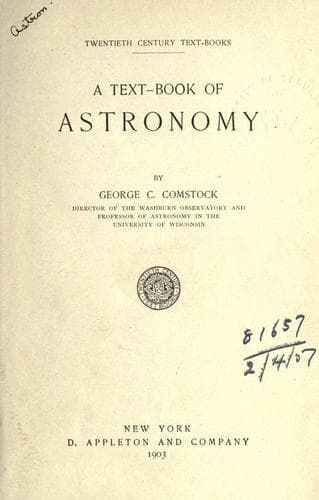
A Text-Book of AstronomyComstock, George C. (George Cary)
Science
A Text-Book of Astronomy
Comstock, George C. (George Cary)
Astronomy
Thus, as we attempt to trace the sun's history into the past, the
farther back we go the greater shall we expect to find its diameter and
the greater the space (volume) through which its molecules are spread.
By reason of this expansion its density must have been less then than
now, and by going far enough back we may even reach a time at which the
density was comparable with what we find in the nebulæ of to-day. If our
ideas of the sun's present mechanism are sound, then, as a necessary
consequence of these, its past career must have been a process of
condensation in which its component particles were year by year packed
closer together by their own attraction for each other. As we have seen
in § 126, this condensation necessarily developed heat, a part of which
was radiated away as fast as produced, while the remainder was stored
up, and served to raise the temperature of the sun to what we find it
now. At the present time this temperature is a chief obstacle to further
shrinkage, and so powerfully opposes the gravitative forces as to
maintain nearly an equilibrium with them, thus causing a very slow rate
of further condensation. But it is not probable that this was always so.
In the early stages of the sun's history, when the temperature was low,
contraction of its bulk must have been more rapid, and attempts have
been made by the mathematicians to measure its rate of progress and to
determine how long a time has been consumed in the development of the
present sun from a primitive nebulous condition in which it filled a
space of greater diameter than Neptune's orbit. Of course, numerical
precision is not to be expected in results of this kind, but, from a
consideration of the greatest amount of heat that could be furnished by
the shrinkage of a mass equal to that of the sun, it seems that the
period of this development is to be measured in tens of millions or
possibly hundreds of millions of years, but almost certainly does not
reach a thousand millions.
Public-domain text, read in full here on John Shaqi.
Reviews
Reviews
No reviews yet
Be the first to share your thoughts on this work.
Elsewhere in the archive
Join the Discussion
Join the discussion
Sign in to leave a comment or review.
Sign InorCreate an account