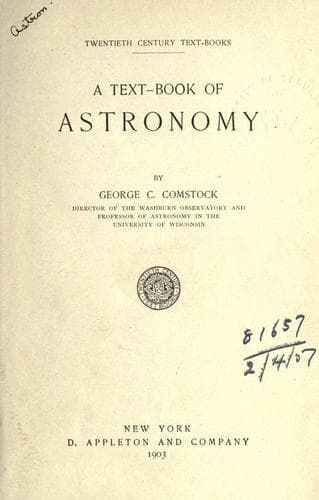
A Text-Book of AstronomyComstock, George C. (George Cary)
Science
A Text-Book of Astronomy
Comstock, George C. (George Cary)
Astronomy
The second basis of our inquiry is: The assumed permanence of natural
laws. The law of gravitation certainly held true a century ago as well
as a year ago, and for aught we know to the contrary it may have been a
law of the universe for untold millions of years; but that it has
prevailed for so long a time is a pure assumption, although a necessary
one for our purpose. So with those other laws of mathematics and
mechanics and physics and chemistry to which we must appeal; if there
was ever a time or place in which they did not hold true, that time and
place lie beyond the scope of our inquiry, and are in the domain
inaccessible to scientific research. It is for this reason that science
knows nothing and can know nothing of a creation or an end of the
universe, but considers only its orderly development within limited
periods of time. What kind of a past universe would, under the operation
of known laws, develop into the present one, is the question with which
we have to deal, and of it we may say with Helmholtz: "From the
standpoint of science this is no idle speculation but an inquiry
concerning the limitations of its methods and the scope of its known
laws."
To ferret out the processes by which the heavenly bodies have been
brought to their present condition we seek first of all for lines of
development now in progress which tend to change the existing order of
things into something different, and, having found these, to trace their
effects into both past and future. Any force, however small, or any
process, however slow, may produce great results if it works always and
ceaselessly in the same direction, and it is in these processes, whose
trend is never reversed, that we find a partial clew to both past and
future.
228. THE SUN'S DEVELOPMENT.--The first of these to claim our attention
is the shrinking of the sun's diameter which, as we have seen in Chapter
X, is the means by which the solar output of radiant energy is
maintained from year to year. Its amount, only a few feet per annum, is
far too small to be measured with any telescope; but it is cumulative,
working century after century in the same direction, and, given time
enough, it will produce in the future, and must have produced in the
past, enormous transformations in the sun's bulk and equally significant
changes in its physical condition.
Public-domain text, read in full here on John Shaqi.
Reviews
Reviews
No reviews yet
Be the first to share your thoughts on this work.
Elsewhere in the archive
Join the Discussion
Join the discussion
Sign in to leave a comment or review.
Sign InorCreate an account