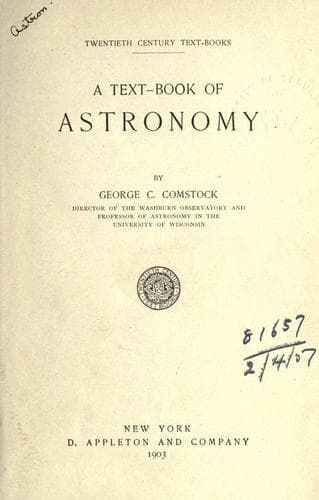
A Text-Book of AstronomyComstock, George C. (George Cary)
Science
A Text-Book of Astronomy
Comstock, George C. (George Cary)
Astronomy
For millions of years to come, if moon and earth endure so long, the
distance between them must go on increasing, although at an ever slower
rate, since the farther away the moon goes the smaller will be the tides
and the slower the working out of their results. On the other hand, when
the moon was nearer the earth than now, tidal influences must have been
greater and their effects more rapidly produced than at the present
time, particularly if, as seems probable, at some past epoch the earth
was hot and plastic like Jupiter and Saturn. Then, instead of tides in
the water of the sea, such as we now have, the whole substance of the
earth would respond to the moon's attraction in _bodily tides_ of
semi-fluid matter not only higher, but with greater internal friction of
their molecules one upon another, and correspondingly greater effect in
checking the earth's rotation.
But, whether the tide be a bodily one or confined to the waters of the
sea, so long as the moon causes it to flow there will be a certain
amount of friction which will affect the earth much as a brake affects a
revolving wheel, slowing down its motion, and producing thus a longer
day as well as a longer month on account of the moon's increased
distance. Slowing down the earth's rotation is the direct action of the
moon upon the earth. Pushing the moon away is the form in which the
earth's equal and contrary reaction manifests itself.
235. CONSEQUENCES OF TIDAL FRICTION UPON THE MOON.--When the moon was
plastic the earth must have raised in it a bodily tide manifold greater
than the lunar tides upon the earth, and, as we have seen in Chapter IX,
this tide has long since worn out the greater part of the moon's
rotation and brought our satellite to the condition in which it presents
always the same face toward the earth.
Public-domain text, read in full here on John Shaqi.
Reviews
Reviews
No reviews yet
Be the first to share your thoughts on this work.
Elsewhere in the archive
Join the Discussion
Join the discussion
Sign in to leave a comment or review.
Sign InorCreate an account