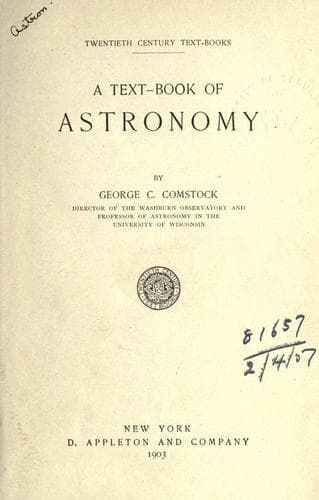
A Text-Book of AstronomyComstock, George C. (George Cary)
Science
A Text-Book of Astronomy
Comstock, George C. (George Cary)
Astronomy
These two processes, slowing down the rotation and pushing away the
disturbing body, are inseparable--one requires the other; and it is
worth noting in this connection that when for any reason the tide ceases
to flow, and the tidal wave takes up a permanent position, as it has in
the moon (§ 99), its work is ended, for when there is no motion of the
wave there can be no friction to further reduce the rate of rotation of
the one body, and no reaction to that friction to push away the other.
But this permanent and stationary tidal wave in the moon, or elsewhere,
means that the satellite presents always the same face toward its
planet, moving once about its orbit in the time required for one
revolution upon its axis, and the tide raised by the moon upon the earth
tends to produce here the result long since achieved in our satellite,
to make our day and month of equal length, and to make the earth turn
always the same side toward the moon. But the moon's tidal force is
small compared with that of the earth, and has a vastly greater momentum
to overcome, so that its work upon the earth is not yet complete.
According to Thomson and Tait, the moon must be pushed off another
hundred thousand miles, and the day lengthened out by tidal influence to
seven of our present weeks before the day and the lunar month are made
of equal length, and the moon thereby permanently hidden from one
hemisphere of the earth.
236. THE EARTH-MOON SYSTEM.--Retracing into the past the course of
development of the earth and moon, it is possible to reach back by means
of the mathematical theory of tidal friction to a time at which these
bodies were much nearer to each other than now, but it has not been
found possible to trace out the mode of their separation from one body
into two, as is supposed in the nebular theory. In the earliest part of
their history accessible to mathematical analysis they are distinct
bodies at some considerable distance from each other, with the earth
rotating about an axis more nearly perpendicular to the moon's orbit and
to the ecliptic than is now the case. Starting from such a condition,
the lunar tides, according to Darwin, have been instrumental in tipping
the earth's rotation axis into its present oblique position, and in
determining the eccentricity of the moon's orbit and its position with
respect to the ecliptic as well as the present length of day and month.
Public-domain text, read in full here on John Shaqi.
Reviews
Reviews
No reviews yet
Be the first to share your thoughts on this work.
Elsewhere in the archive
Join the Discussion
Join the discussion
Sign in to leave a comment or review.
Sign InorCreate an account