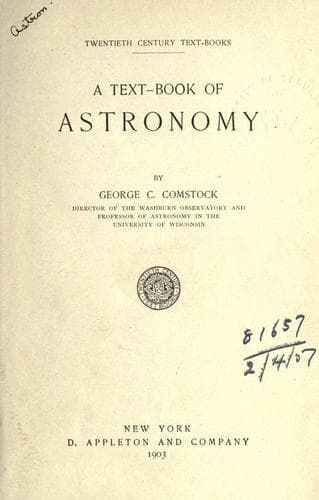
A Text-Book of AstronomyComstock, George C. (George Cary)
Science
A Text-Book of Astronomy
Comstock, George C. (George Cary)
Astronomy
337. TIDAL FRICTION UPON THE PLANETS.--The satellites of the outer
planets are equally subject to influences of this kind, and there
appears to be independent evidence that some of them, at least, turn
always the same face toward their respective planets, indicating that
the work of tidal friction has here been accomplished. We saw in Chapter
XI that it is at present an open question whether the inner planets,
Venus and Mercury, do not always turn the same face toward the sun,
their day and year being of equal length. In addition to the direct
observational evidence upon this point, Schiaparelli has sought to show
by an appeal to tidal theory that such is probably the case, at least
for Mercury, since the tidal forces which tend to bring about this
result in that planet are about as great as the forces which have
certainly produced it in the case of the moon and Saturn's satellite,
Japetus. The same line of reasoning would show that every satellite in
the solar system, save possibly the newly discovered ninth satellite of
Saturn, must, as a consequence of tidal friction, turn always the same
face toward its planet.
238. THE SOLAR TIDE.--The sun also raises tides in the earth, and their
influence must be similar in character to that of the lunar tides,
checking the rotation of the earth and thrusting earth and sun apart,
although quantitatively these effects are small compared with those of
the moon. They must, however, continue so long as the solar tide lasts,
possibly until the day and year are made of equal length--i. e., they
may continue long after the lunar tidal influence has ceased to push
earth and moon apart. Should this be the case, a curious inverse effect
will be produced. The day being then longer than the month, the moon
will again raise a tide in the earth which will run around it _from west
to east_, opposite to the course of the present tide, thus tending to
accelerate the earth's rotation, and by its reaction to bring the moon
back toward the earth again, and ultimately to fall upon it.
We may note that an effect of this kind must be in progress now between
Mars and its inner satellite, Phobos, whose time of orbital revolution
is only one third of a Martian day. It seems probable that this
satellite is in the last stages of its existence as an independent body,
and must ultimately fall into Mars.
Public-domain text, read in full here on John Shaqi.
Reviews
Reviews
No reviews yet
Be the first to share your thoughts on this work.
Elsewhere in the archive
Join the Discussion
Join the discussion
Sign in to leave a comment or review.
Sign InorCreate an account