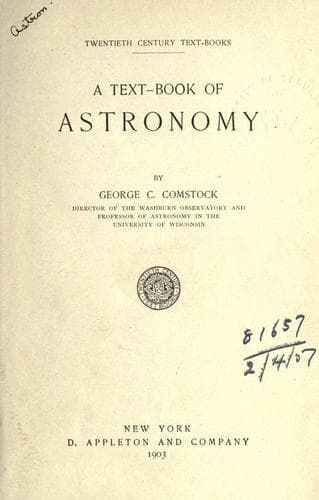
A Text-Book of AstronomyComstock, George C. (George Cary)
Science
A Text-Book of Astronomy
Comstock, George C. (George Cary)
Astronomy
What planet is the evening star _now_? Is there more than one evening
star at a time? What is the morning star now?
Do Mercury, Venus, or Mars ever appear in opposition? What is the
maximum angular distance from the sun at which Venus can ever be seen?
Why is Mercury a more difficult planet to see than Venus? In what month
of the year does Mars come nearest to the earth? Will it always be
brighter in this month than in any other? Which of all the planets comes
nearest to the earth?
The earth always comes to the same longitude on the same day of each
year. Why is not this true of the other planets?
The student should remember that in one respect Figs. 16 and 17 are not
altogether correct representations, since they show the orbits as all
lying in the same plane. If this were strictly true, every planet would
move, like the sun, always along the ecliptic; but in fact all of the
orbits are tilted a little out of the plane of the ecliptic and every
planet in its motion deviates a little from the ecliptic, first to one
side then to the other; but not even Mars, which is the most erratic in
this respect, ever gets more than eight degrees away from the ecliptic,
and for the most part all of them are much closer to the ecliptic than
this limit.
CHAPTER IV
CELESTIAL MECHANICS
32. THE BEGINNINGS OF CELESTIAL MECHANICS.--From the earliest dawn of
civilization, long before the beginnings of written history, the motions
of sun and moon and planets among the stars from constellation to
constellation had commanded the attention of thinking men, particularly
of the class of priests. The religions of which they were the guardians
and teachers stood in closest relations with the movements of the stars,
and their own power and influence were increased by a knowledge of them.
[Illustration: ISAAC NEWTON (1643-1727).]
Public-domain text, read in full here on John Shaqi.
Reviews
Reviews
No reviews yet
Be the first to share your thoughts on this work.
Join the Discussion
Join the discussion
Sign in to leave a comment or review.
Sign InorCreate an account